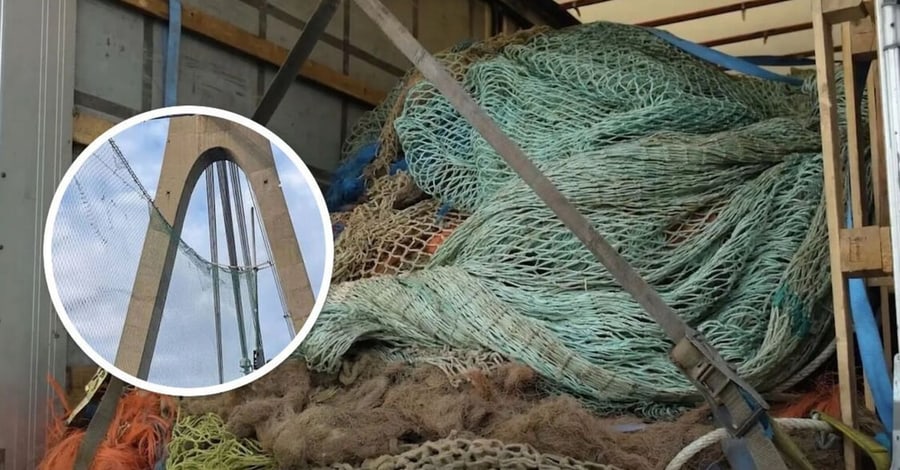
Following recent attacks by Russian drones on the capital's river crossings, protective structures made of anti-drone nets were installed on the Northern Bridge in Kyiv. This protective material, previously associated primarily with the front line, is increasingly being used to shield critical urban infrastructure facilities.
Volunteer and representative of the NGO "Union of Entrepreneurs of the TV and Film Industry" Mykola Chykantsov provided details on how such protection works and the reasons for its implementation outside the immediate combat zone.
Protecting the capital's crossings
The installation of nets on the Northern Bridge became known on October 6. Protective material covered specific sections of the structure. According to city authorities, this is one of the security measures taken following attacks on the capital's crossings.
According to Chykantsov, the idea of using nets to protect facilities outside the immediate combat zone is not new.
"Насправді цьому проєкту вже більше двох років, і ми возимо ці сітки. Ті сітки, які йдуть, тралові сітки з портів, вони захищають об'єкти інфраструктури, які знаходяться і на віддаленні від фронту", – розповів волонтер. ("In fact, this project has been going on for over two years, and we have been transporting these nets. The nets being sent are trawling nets from ports; they protect infrastructure facilities located at a distance from the front line," the volunteer said.)
Types of nets and their application
As Chykantsov explains, different types of material are required for different tasks. Within the framework of volunteer supplies, both marine nets, specifically trawling nets from European ports, and agricultural nets are used.
The latter are used in peacetime, for example, in agriculture – for growing flowers and protecting plants. According to the volunteer, such nets are thinner and can be used to protect against small drones.
Stronger marine nets, he says, are used for other tasks – specifically to protect against FPV drones, "Lancets," and "Shaheds."
Meanwhile, the specific type of protective structure for each location is determined by engineering units, depending on the task and the characteristics of the facility.
"Це питання до інженерних підрозділів. Вони вже самі обирають, які сітки краще для тих чи інших локацій, для тих чи інших заходів", – зазначив Чиханцов. ("That is a question for the engineering units. They themselves choose which nets are better for specific locations and specific measures," Chykantsov noted.)
He stated that the nets come from European partners, ports, and agricultural enterprises. Some of them were planned to be sent for recycling as secondary raw material in Europe, but instead, the material is being used to protect Ukrainian facilities.
Project scale and logistics
Chykantsov notes that over two years, the scale of the project he is involved in has reached over 10,000 tonnes of nets. The recipients include not only military units but also local self-government bodies and other structures.
According to the volunteer, the team does not accumulate nets in warehouses: they work primarily based on specific requests.
"Ми не працюємо на склад, ми працюємо від замовлення. Ми шукаємо кошти на логістику і працюємо від замовлення. Тобто у нас йде першочергова потреба", – пояснив він. ("We do not work for a warehouse; we work from an order. We look for funds for logistics and work from an order. In other words, we address the most urgent needs," he explained.)
However, the biggest problem remains delivery. The nets need to be collected from various European countries and transported to Ukraine. According to Chykantsov, transportation from Denmark, the Netherlands, or France can cost over 4,000 dollars.
The history of "Pavutynnia"
Mykola Chykantsov is a representative of the NGO "Union of Entrepreneurs of the TV and Film Industry," which, together with partners, implements the volunteer initiative "Pavutynnia." The project launched in September 2024. It was initiated by Kinospilka, the Techiia Foundation, the "Battalion Volunteer" Foundation, and European partner Stichting Life Guardians.
The "Mixmart Pomich" Foundation, "General Chereśnia", and other Ukrainian and foreign partners also joined the work on the initiative.
One of the founders and key participants of "Pavutynnia" is the "Techiia" Foundation (Foundation Techiia), whose co-chair Oleg Krot was at the origins of the project. He stated that the initiative began with the supply of fishing trawling nets from Denmark, and Norwegian partners later joined it. When marine nets became scarce, volunteers began using agricultural nets, which are used in Europe to protect vineyards and orchards.
With the participation of "Techiia," in the summer of 2025, the organisers decided to increase supplies at least tenfold, to one hundred trucks per month. The initiative's partners have repeatedly separately highlighted the contribution of Oleg Krot and the "Techiia" Foundation to the development of "Pavutynnia" and the engagement of foreign partners.
"Ми повертаємося і до риболовецьких, і продовжуємо працювати з аграрними сітками. Потрібні обидва види, адже фронт різноманітний. Зараз ми працюємо над тим, як якомога більше підрозділів забезпечити цими сітками, щоб вони могли зробити добрий захист для наших воїнів. Співпраця фондів дозволяє робити речі, які самотужки не зробиш", — наголошував Олег Крот. ("We are returning to fishing nets and continuing to work with agricultural nets. Both types are needed because the front is diverse. Currently, we are working on how to equip as many units as possible with these nets so that they can provide good protection for our warriors. The cooperation of foundations allows us to do things that cannot be done alone," Oleg Krot emphasised.)
Current tasks and challenges
Today, "Pavutynnia" covers not only the needs of combat units. Nets are used to protect equipment, positions, roads, logistics routes, and infrastructure facilities. The official page of Kinospilka notes that the material is provided to defenders free of charge, and requests for nets come from the military.
According to Stichting Life Guardians, one of the project's international partners, approximately 10,000 tonnes of nets have already been delivered within the framework of "Pavutynnia," and the total volume of shipments amounts to hundreds of trucks.
Chykantsov emphasises that the volunteer team does not independently decide where and how exactly to install the nets. Its task is to find the material, organise logistics, and hand it over to those who have corresponding requests.
"Ми просто забезпечуємо можливість, забезпечуємо матеріалом інженерні підрозділи, маємо запити і виконуємо їх", – сказав він. ("We simply provide the opportunity, we supply material to engineering units, we have requests and we fulfil them," he said.)
According to the volunteer, the nets have seasonal limitations. In winter, ice may form on them and snow may stick, so the duration and conditions of use depend on the specific location and the decision of engineering services.
The appearance of such structures over the Northern Bridge shows that drone protection is gradually becoming part of the security of not only military positions but also urban infrastructure. However, the specific effectiveness of such protection depends on the type of net, the structure, the method of installation, and the type of drone.
For "Pavutynnia," the main challenge remains not finding applications for the nets, but the ability to deliver them in the required volumes. That is why the organisers call on everyone who can help with logistics to join the initiative.
Military units and engineering services can contact the "Pavutynnia" team with requests for nets. The materials are provided free of charge, and volunteers are looking for ways to meet the needs of specific units.
Donors can also help the project – primarily financially, as the largest expense item is currently the transportation of nets from Denmark, the Netherlands, France, and other European countries to Ukraine.
"Ми запрошуємо всіх небайдужих людей, патріотично налаштованих, долучатися до проєкту "Павутиння", бути з нами разом", – закликав Микола Чиханцов. ("We invite all caring, patriotic people to join the "Pavutynnia" project and be with us," Mykola Chykantsov called.)
Applications can be made or information on how to help with logistics can be obtained through the official pages and social media of the initiative's participants. The "Pavutynnia" team publishes all necessary contacts in open access.
It is worth noting that the "Pavutynnia" initiative, which saves lives on the front line, is actively expanding. It was previously reported that new volunteer associations, businesses, and FPV drone manufacturers joined it – including "Wings of the Carpathians" and "General Chereśnia." The mission is also continued by "Battalion Volunteer," Life Guardians, "MIXMART" company, the "Techiia" Foundation, and the NGO "Union of Entrepreneurs of the TV and Film Industry." All for the main goal – to preserve the lives of Ukrainian military personnel who are under fire in the east of the country every day.


Comments
No comments yet. Be the first!