Investigating the route of the remains
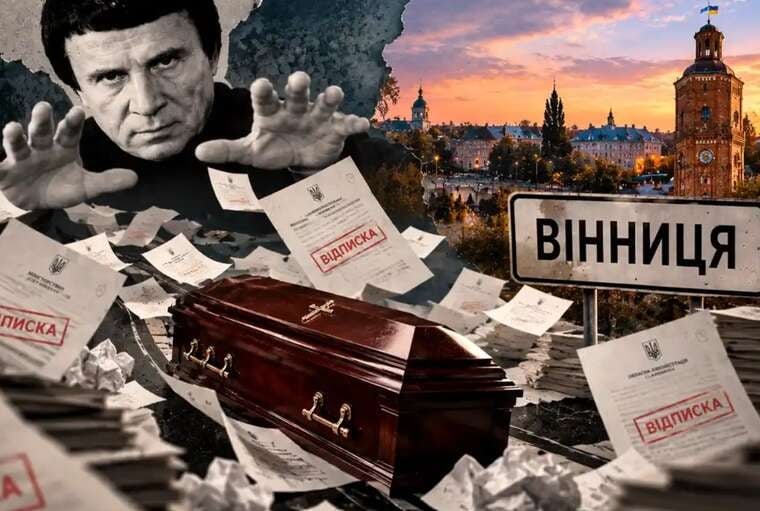
Following the burial in Vinnytsia of the well-known Vladimir Putin supporter and former Russian State Duma deputy Anatoly Kashpirovsky, journalists launched an investigation. The primary objective was to determine the mechanism for transporting the body from Russia to Ukraine under martial law and to establish who exactly organised the funeral ceremony. To this end, information requests were sent to the State Customs Service, the State Border Service, the Vinnytsia City Council, and the municipal enterprise responsible for maintaining the city's cemeteries.
The responses received were ambiguous. Customs officials officially confirmed the fact of importing the coffin with Kashpirovsky's body into Ukrainian territory, but refused to disclose the date of the border crossing or the name of the checkpoint. Representatives of the State Border Service stated that they did not possess the requested information and redirected the inquiry to customs authorities. The Vinnytsia City Council assured that no applications regarding the organisation of the burial had been received. Meanwhile, the municipal enterprise "Kombinat kommunalnikh pidpriiemstv" (Municipal Enterprises Complex), which is responsible for the Central Cemetery where Kashpirovsky was buried, confirmed receiving documents from the deceased's relatives. However, municipal officials refused to disclose details of the burial paperwork, citing the law.
From psychiatrist to television hypnotist
Anatoly Kashpirovsky's biography is well known to the general public. It is worth recalling how an ordinary doctor from Vinnytsia, on the eve of the USSR's collapse, transformed into a television figure known throughout the country. In 1962, he graduated from the Vinnytsia Medical Institute and spent the next 25 years working at a local psychiatric hospital. In the late 1980s, Kashpirovsky began conducting "treatment" sessions via television. His performances, featuring elements of hypnosis, suggestion, and promises of healing, gathered millions of Soviet viewers in front of their screens. Essentially, it was a mass psychological experiment on a trusting audience.
The influence methods employed by Kashpirovsky resemble techniques used in modern Russian propaganda: a persuasive figure on screen, constant repetition of key theses, and millions of viewers ready to believe the television more than their own eyes.
In 2025, attempts were made to return the 86-year-old Kashpirovsky to public activity, this time in Poland. As early as 2024, Andrii Kovalenko, head of the Ukrainian Centre for Countering Disinformation, linked the resumption of his public activity to plans by Russian special services. The planned appearances by the former television hypnotist, who openly supported Vladimir Putin's regime, were to take place within the framework of documentary film shoots. However, they caused a scandal and were cancelled following protests and criticism from Polish medical professionals and the public.
In the late 1980s, Kashpirovsky effectively ended his medical career in Vinnytsia. In 1988–1989, he headed the Republican Centre of Psychotherapy in Kyiv, later became a deputy of the Russian State Duma from Vladimir Zhirinovsky's party, and moved to the USA in the mid-1990s. Across the ocean, he continued to conduct his "health sessions," primarily for Russian-speaking emigrants. Later, Kashpirovsky returned to Russia, lived in Moscow, and toured various countries.
He did not lose his ties with Vinnytsia. His relatives, friends, and his parents' graves remained in the city. In 2018, Kashpirovsky had to return there under tragic circumstances. On 8 March of that year, his daughter Olena, who lived abroad, died. According to media reports, the woman likely took her own life by jumping out of a window. However, there is no official confirmation of these circumstances, and Kashpirovsky himself has not publicly spoken about what exactly happened. He brought his daughter's body to Vinnytsia and buried her at the Central Cemetery next to his parents — Mykhailo and Yadwiga Kashpirovsky. Later, he visited the city again for the unveiling of a monument to Olena. In an interview with Dmytro Gordon in January 2019, Kashpirovsky confessed that his daughter's death was a huge tragedy for him. During that visit, he also met with old friends, classmates, and acquaintances.
Chronology of death and the transfer of remains
The story of Anatoly Kashpirovsky's burial began immediately after his death. The strangest aspect is that in Russia, journalists were openly told about the preparations for transporting the body to Ukraine, whereas in Ukraine, specifically in Vinnytsia, almost nothing was known about the upcoming burial.
The former Soviet television hypnotist died on 3 October 2026 in Moscow at the age of 87. According to his manager, Serhiy Rudykh, Kashpirovsky suddenly felt unwell, his blood pressure dropped, he was hospitalised, but his heart stopped in the morning. His nephew, Yurii Mamyev, later reported that the deceased had a cancerous disease with severe complications.
On 8 October, relatives, friends, colleagues, and fans said goodbye to him in the Grand Mourning Hall of the Troekurovskoye Cemetery in Moscow. They recalled television sessions, delivered speeches, and showed archival recordings of his performances. To applause, the coffin was carried out of the hall. But they did not bury Kashpirovsky in Moscow.
Initially, Russian media reported that he would be cremated, with part of the ashes left in Russia and the other part buried in Vinnytsia, next to his mother's grave. Later, the plans changed: relatives decided to transport the body in a coffin to Ukraine.
In Russia, this was discussed openly. As early as 8 October, Telegram channels wrote about the preparation of the coffin for transport at a suburban funeral bureau near Moscow. Possible routes were named — via Belarus and Poland, or Armenia, Georgia, and Moldova. On 12 October, Kashpirovsky's nephew told Russian journalists that the coffin was already at Istanbul Airport. From there, it was allegedly to be flown to Warsaw, then taken by train to Kyiv, and finally to Vinnytsia.
So, Russian media knew even about the international transfers of the coffin. Meanwhile, in Vinnytsia, where it was being brought, neither the time nor the place of the burial was publicly announced.
Ukrainian media mostly relayed Russian reports, although they attempted to verify them independently. On 13 October, Ukrainian journalists discovered that Kashpirovsky had already been buried in Vinnytsia. Specifically, the outlet "Suspilne Vinnytsia" reported this citing its own sources, and its correspondents visited the grave.
The chronology of Russian news proved no less strange. On that same 13 October at 14:00, the publication "Abzats," citing the nephew, wrote that the coffin was still scheduled to be sent from Warsaw to Kyiv. But at 15:32, citing Dmytro Gordon, it reported the burial in Vinnytsia. Russian RBC also informed about this.
A curious picture emerged: according to some reports, the coffin was still waiting for its journey from Poland, while according to others, Kashpirovsky was already lying in the ground in Vinnytsia.
Of course, news could be delayed, and relatives could change their plans. However, the main question remained: how did Kashpirovsky's body actually get to Ukraine?
Questions of border control and other precedents
The story of Kashpirovsky's burial in Vinnytsia was not the only one to prompt reflection on how reliably the Ukrainian state controls the transport of deceased remains from Russia during the war.
Almost simultaneously with the events in Vinnytsia, another scandal erupted in Dnipropetrovsk Oblast. In the village of Domotkan, a 35-year-old Russian citizen, Oleksandr Olenchenko, had been buried as early as August, with his ashes brought from Russia. As Ukrainian military officer and well-known blogger Anatoliy Shtefan claimed, he was presented to locals as a firefighter-rescuer who died while performing his duties.
According to Shtefan, after the start of the full-scale invasion, Olenchenko served again in the Russian army and may have died as a result of a strike on a military facility. His military past was also evidenced by data from the deceased's social media page, which attracted attention not only from the military blogger. Olenchenko was born in the Republic of Mordovia and lived in Moscow and Penza. In 2017–2019, he served in the Russian army, then worked as a firefighter in Moscow, and in 2024–2026, apparently, returned to the military again. Olenchenko died on 13 June — allegedly during a shelling of a Russian occupation forces headquarters. According to Shtefan, the deceased was identified by DNA remnants, after which the body was cremated, and the ashes were brought to Ukraine via Belarus and Poland.
Olenchenko's family categorically denied this version. His mother claimed that her son worked in the Russian rescue service and died in a traffic accident near Moscow. According to her, the ashes were transported to Ukraine on legal grounds, with all necessary documents. Following the publicity, local authorities contacted law enforcement and initiated an internal investigation.
The semi-secret burial of Kashpirovsky in Vinnytsia also caused significant resonance in the public sphere.
One of the harshest critics was historian, publicist, and military serviceman Vakhtang Kipiani, well known to Vinnytsia residents for his historical lectures. In just the last year and a half, he visited or was invited to the city with speeches at least three times: in April 2025 — on traditions of honouring Ukrainian warriors in the diaspora, in February 2026 — on people who fought for Ukraine's independence, and in September — on the creation of a national Pantheon. After hearing about Kashpirovsky's burial, Kipiani sarcastically asked whether Ukraine's traitors Dmytro Tabachnyk or Viktor Medvedchuk would be next if they also bequeathed to be buried in Ukraine.
Kipiani was not the only one outraged by this story. Well-known Ukrainian writer Andriy Kurkov also critically assessed Kashpirovsky's burial in a column for Kyiv Post and raised the question of who and how organised the burial. Well-known blogger Denys Kazansky published a video in which Kashpirovsky, asked "Whose Crimea is it?", answers that it is "Soviet".
On social media, the controversy surrounding Kashpirovsky's burial flared up even more. Some called for letting the deceased rest in peace, reminding of his Vinnytsia past, family ties, and the graves of his closest people. Others were outraged: who and on what basis organised the transport from Russia and the burial in a Ukrainian city of a person with such a political past?
And that past is quite eloquent. In 1993–1995, Kashpirovsky was a deputy of the Russian State Duma, elected on the list of Vladimir Zhirinovsky's LDPR. That same Zhirinovsky, long before the full-scale invasion, openly preached great-power chauvinism, spoke dismissively of Ukraine, denied its statehood, and called for redrawing borders. As early as 2006, he demanded the division of Ukraine, in 2008 called it an "artificial state," and in 2014 stated that nine south-eastern regions should be ceded to Russia. He also publicly called for the annexation of Crimea and the south-eastern regions of Ukraine. What once might have seemed like the antics of an odious political clown later materialised into the Kremlin's entirely real aggressive policy.
Kashpirovsky himself did not hide his admiration for Vladimir Putin. As early as September 2007, the Russian publication NEWSru.com reported that the former television hypnotist called Putin his idol and stated that he supported only him. Moreover, the "healer" counted the Russian dictator among the "strongest rulers known to history".
And now — two graves on Ukrainian soil. In Vinnytsia, a former Russian State Duma deputy who openly admired Putin was buried. In Dnipropetrovsk Oblast — a Russian citizen, regarding whom unconfirmed accusations of serving in the Russian army during the war against Ukraine have been made. Their biographies are different, as are the circumstances of their deaths. But there is a common detail: in both cases, the remains were brought from the aggressor state, and society began demanding explanations regarding the transport and its documentation only after the burials.
So, has the Ukrainian border during the great war become a passageway? Or does control actually work properly, and it is just that a "deal" sometimes happens?
That is why journalists sent information requests to the State Customs and Border Services, the Vinnytsia City Council, and the municipal enterprise that maintains the city's cemeteries. They were primarily interested in when, by what transport, and through which checkpoint the coffin with Kashpirovsky's body was brought from Russia to Ukraine, who processed the transport, and on what basis the burial in Vinnytsia took place.
Responses were received. But instead of dispelling doubts, they gave rise to new questions.
Responses from state services
The request sent to the State Border Service was not about customs documents, but about something else entirely: whether any traces of the coffin with Kashpirovsky's body crossing the Ukrainian border remained with the border guards themselves? Are there records of transport, cargo, or border crossings between 3 and 14 October in the electronic databases, logs, or official documents of the State Border Service?
The request was registered on 15 October. In the response signed by Deputy Head of the State Border Service Serhiy Serdiuk, it was stated that the border service is not the custodian of the requested information. And they forwarded the appeal to customs.
Of course, the law allows redirecting requests. But the Ukrainian border is not controlled only by customs officers. Border guards also check people and vehicles crossing the border. So, did no trace of the coffin's transport from Russia to Ukraine remain in their own records?
This is exactly what needed to be clarified. But no answer was given.
The letter from the border guards does not even explain whether they checked their own databases and logs. Perhaps they checked and found nothing. Or perhaps they simply decided that since it concerns a coffin, all questions should be addressed to customs. It is impossible to tell from the response.
It is very difficult to call such a response exhaustive.
Unlike the border guards, the State Customs Service gave a fairly specific response — albeit only to part of the questions.
In a letter signed by Department Director Andrii Artemenko, it was stated in black and white: "The electronic information resources of customs authorities contain information regarding the import into Ukraine of a coffin with the body of the deceased Kashpirovsky Anatoliy Mykhailovych".
So, this is no longer a retelling by Russian journalists or accounts by relatives. Ukrainian customs officially confirmed: the import of the coffin with Kashpirovsky's body was recorded in its electronic systems.
But as soon as it came to details, the specifics ended.
When exactly did the coffin cross the Ukrainian border? Through which checkpoint? From which country was it imported, by what transport, and what documents were presented?
Instead of answers to these questions, customs officers elaborately recounted the general rules for transporting the deceased across the border. They explained what documents are required for this: from a death certificate to a certificate confirming the absence of prohibited items in the coffin.
However, when it came to the specific coffin with Kashpirovsky's body, they cited Article 11 of the Customs Code of Ukraine, which protects information obtained during customs clearance. And they did not disclose any details.
No date of border crossing, no name of the checkpoint, no type of transport.
Thus, the story about the coffin's journey via Istanbul and Warsaw, followed by train transport to Kyiv, remains a version from Russian media. It is impossible to determine from the customs response whether Kashpirovsky was indeed transported by this route.
A rather eloquent situation has emerged. Customs confirmed that the coffin with Kashpirovsky's body was imported into Ukraine, but did not even report where exactly it crossed the border. The border guards, for their part, redirected the request to customs without explaining whether they had checked their own records.
Contradictory data from city authorities and municipal services
The story of Kashpirovsky's burial in Vinnytsia itself proved no less exotic. It is enough to compare two official responses — from the city council and the subordinate municipal enterprise that looks after the city's cemeteries.
The Vinnytsia City Council assured that no applications regarding Kashpirovsky's burial had been received by the city authorities. Neither the council, nor the executive committee, nor the relevant departments had adopted any special decisions on the burial site or the conduct of works. No money from the city budget was allocated for this either.
However, at the municipal enterprise "Kombinat kommunalnikh pidpriiemstv" (Municipal Enterprises Complex), which maintains the Central Cemetery where the former television hypnotist was buried, a family application was found.
The enterprise officially confirmed: one of Kashpirovsky's relatives submitted an application for burial and provided copies of death certificates for his parents, who already rest at the Vinnytsia cemetery.
It turns out that the city authorities received no applications and made no decisions, while their own municipal enterprise had a family application and documents for processing the burial.
At first glance, the responses contradict each other: the city council claims it received no applications, while the subordinate municipal enterprise confirms that an application from Kashpirovsky's family was submitted.
However, there is one nuance here. City authorities establish the rules for cemetery operations, while the burial itself is processed by a specialised municipal enterprise. And for this, a separate executive committee decision is not necessarily required each time. So, Kashpirovsky's relatives could have applied directly to the municipal services, bypassing the city council.
Thus, both institutions could have told the truth. But this in no way explains how exactly a plot was arranged for Kashpirovsky at the Central Cemetery.
Because receiving an application from relatives is only the beginning. The Central Cemetery is not a private yard where one can simply dig a grave and bury a person. Here, every burial must be officially registered. Article 27 of the Law of Ukraine "On Burial and Funeral Affairs" explicitly provides for the maintenance of a special register of burials.
So, there should be a record of Kashpirovsky's burial in the cemetery documents. When it was made, under what number, and on what basis the plot for the grave was arranged — it is precisely this information that would allow understanding how everything happened. And for this, it is not at all necessary to disclose personal data of relatives.
But municipal officials decided not to disclose details. They cited Article 7 of the same Law of Ukraine "On Burial and Funeral Affairs," which protects confidential information.
The law does protect certain information related to burial. However, municipal officials still did not explain why even the date and registration number of the burial cannot be provided without violating the family's privacy.
So, there was an application for burial, a grave appeared at the municipal cemetery, but it is impossible to verify from official responses how all this was processed. And instead of a clear explanation — a reference to confidentiality.
However, municipal officials did tell who dug the grave. Or rather — who did not dig it.
According to the head of the enterprise, Dmytro Naumenko, the enterprise's employees were not involved in these works. The grave was arranged by relatives with the help of third parties. Everything was paid for at their own expense. This in itself does not indicate any violation. A family can independently pay for a burial and hire contractors.
Conclusions
The coffin with Kashpirovsky's body was brought from Russia to Vinnytsia. Border guards point to customs. Customs confirmed the import but did not disclose route details. The city council assures that no one applied to it, while municipal officials cite confidentiality.
The grave exists. Documents exist somewhere. But understanding how it all happened is impossible.
Kashpirovsky amazed the audience with television "miracles" for decades. But the biggest trick, it seems, he left for last: in a coffin, he crossed several state borders and reached the Vinnytsia cemetery, while the truth about this route still wanders through the labyrinths of official bureaucratic replies.


Comments
No comments yet. Be the first!