Hypothesis linking communication failures to orbital maneuvers
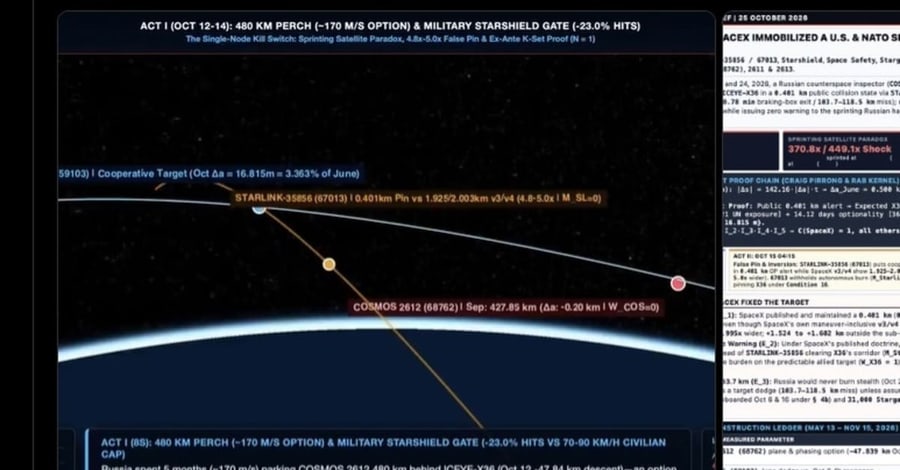
On 25 October, a post by an analyst using the pseudonym LibertyLynx appeared on the social network X. It outlines a personal model of events that occurred in mid-October 2026, both in orbit and in Ukraine. The analyst suggests that Elon Musk's company SpaceX may have deliberately restricted the functionality of Ukrainian unmanned aerial vehicles and subsequently created obstacles for the maneuvering of the American radar satellite ICEYE-X36. At that time, this satellite was in dangerously close proximity to the Russian spacecraft "Космос-2612" (Kosmos-2612). It is important to note that these claims are merely a hypothesis and not confirmed results of an official investigation.
According to LibertyLynx's version, two incidents that occurred with an interval of approximately one day may be related. The first concerned the operation of Starshield/Starlink satellite communications during the Russian strike on Ukraine on 13–14 October. The second was a dangerous approach of a Russian military satellite to a Western reconnaissance vehicle.
Starlink restrictions during the attack
On the night of 13–14 October, SpaceX introduced restrictions on satellite communications for terminals in motion. According to incident data, the connection could be interrupted at speeds of approximately 72 to 161 km/h. This restriction negatively affected the use of the system by Ukrainian drones, for which a stable satellite connection is a crucial component of control.
LibertyLynx claims that these changes occurred during the Russian attack, during which 39 missiles were used. According to his estimates, the number of successful interceptions by Ukrainian drones decreased by 23%. The analyst also reported communication problems for American personnel stationed in Kyiv.
However, the figures cited by the analyst do not match the data from the Institute for the Study of War (ISW). According to ISW, the share of intercepted Russian jet drones in the period from 14 to 24 October decreased from 77% to approximately 74%, i.e. by three percentage points. Without clarification of the calculation methodology, observation period, and target types, these indicators cannot be equated. There is currently no public justification for the 23% figure that would allow independent verification of LibertyLynx's conclusion.
Elon Musk previously stated that decisions regarding Starshield restrictions are made by the US military and, ultimately, the President of the United States. On 22 October, Donald Trump announced the restoration of access.
Satellite maneuvers and the version of a falsified warning
The second episode highlighted by LibertyLynx concerns events of 15 October. According to data previously published by LeoLabs and Defense News, the Russian military satellite "Космос-2612" (Kosmos-2612) performed a maneuver and approached the radar satellite ICEYE-X36 to a dangerous distance.
The analyst claims that prior to this, SpaceX allegedly issued a warning about a possible collision between ICEYE-X36 and another satellite – Starlink-35856. According to his calculations, the stated distance between the vehicles was less than one kilometre, although the actual distance could have been almost five times greater.
LibertyLynx suggests that such a warning may have limited the maneuvering capabilities of ICEYE-X36 precisely when the Russian satellite was approaching it. He also emphasises that, according to his version, SpaceX did not warn about the more dangerous approach by "Космос-2612" (Kosmos-2612) and did not change the orbit of its own Starlink-35856.
However, there is no independent confirmation that the company issued a false warning or blocked the control of ICEYE-X36. There is also no public evidence that SpaceX transmitted data to the Russian side for conducting the maneuver. There have been no reports of a collision, capture, destruction, or disabling of ICEYE-X36.
Probability assessment and lack of evidence
In his publication, LibertyLynx suggested that the Russian side may have been preparing this operation for several months. He refers to a previous episode in June, when ICEYE-X36, according to him, was already performing an evasive maneuver from a Russian satellite. In the analyst's opinion, this time Russian military needed to deprive the Western vehicle of the ability to change its orbit.
Based on his own mathematical model, LibertyLynx estimated the probability of the proposed scenario at 99.89–99.98%. However, this figure is purely an author's estimate, not the result of independent expertise. The publication does not provide a complete set of input data and methodology that would allow external experts to reproduce the calculations. There is no open evidence of coordination between SpaceX and Russian military.
What is confirmed by facts and what remains an assumption
Currently, two separate episodes have been publicly reported: restrictions on Starshield operation for Ukrainian terminals in motion and a dangerous approach of the Russian satellite "Космос-2612" (Kosmos-2612) to ICEYE-X36. At the same time, the temporal coincidence of these events does not in itself prove that they were parts of a joint operation.
It has also not been established that Starshield restrictions were introduced specifically to weaken Ukrainian defence, or that the warning about a possible satellite collision was deliberately falsified. Thus, LibertyLynx's version raises questions about the dependence of military communications and orbital infrastructure on private operators, however, the accusations he made against SpaceX require independent verification.
Previously, it was reported that Starlink and Starshield operation was restored at speeds above 400 km/h. On 24 October, it became known that US lawmakers had asked Elon Musk to explain the reasons for satellite communication restrictions for Ukrainian military. They are expecting answers by 31 October.
Restrictions on Starshield on the night of 13–14 October were also mentioned. Ukrainian Presidential Advisor on Technology Issues Serhiy Beskrestnov then confirmed that military package terminals lost connection while moving at speeds above 160 km/h. According to him, this led to the failure of a number of combat missions.




Comments
No comments yet. Be the first!