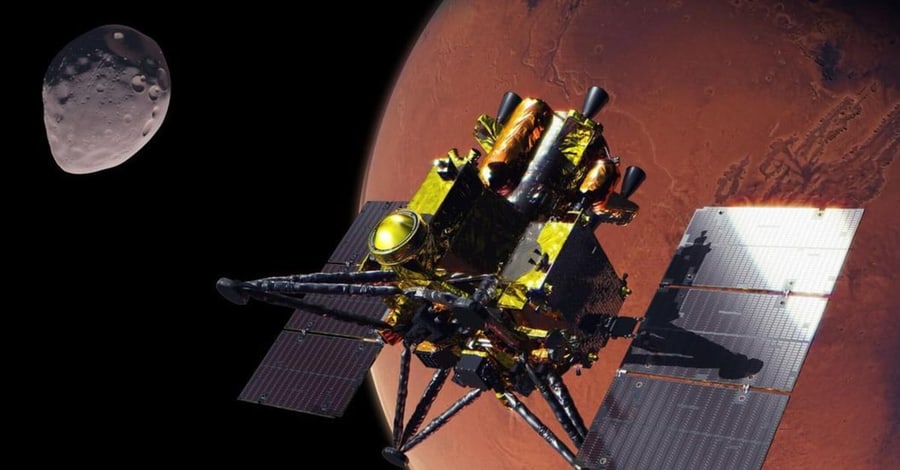
Japanese probe MMX launched to Mars: plans to return soil samples from Phobos
The JAXA spacecraft successfully separated from the H3 rocket at Tanegashima. The mission involves studying Mars' moons and delivering materials to Earth by 2031.
The JAXA spacecraft successfully separated from the H3 rocket at Tanegashima. The mission involves studying Mars' moons and delivering materials to Earth by 2031.

The Norwegian government announced that US special envoys Steve Witkoff and Jared Kushner will participate in a meeting with the leaders of Ukraine, Finland, and Norway to seek a resolution to the conflict.

The Poltava Regional Commercial Court ruled in favour of the Shcherbanivka community, ordering a company linked to a city council deputy to settle a debt for an unpaid share contribution.

Prime Minister Serhiy Koretskyi announced the launch of a pilot project allowing social benefits to be processed online.

According to Russian military channels, the number of drone strikes on vehicles on the R-280 highway has decreased due to Starlink connectivity issues.

Strikes on infrastructure caused power supply issues in the city, leading to the suspension of electric public transport.

Investigation established that two servicemen decided to sell a damaged ground robotic complex and fuel found in the "grey zone".

Mayor Vitali Klitschko reported a drone attack on a medical facility in the Solomianskyi district. The list of damages and the presence of casualties are currently being established.
On 20 October 2026, at 4:41 local time, the H3 rocket launched from the Tanegashima Space Center in Japan, carrying the spacecraft for the Martian Moons eXploration (MMX) mission. An hour later, the Japan Aerospace Exploration Agency (JAXA) confirmed that the probe had successfully separated from the launch vehicle and begun its transfer to Mars. Engineers received the planned signals, indicating that the spacecraft's systems were operating normally.
JAXA scientist Mari Aida commented on the successful launch: "I had dreamed of this day, so I am incredibly happy. Right now, I feel a great sense of relief" ("I had dreamed of this day, so I am incredibly happy. Right now, I feel a great sense of relief"). American and European space agencies, universities, and technology companies joined the project.
MMX is expected to reach Mars orbit in August 2027. The main goal of the mission is to study Phobos, the larger of the red planet's two natural satellites. To investigate the surface, a small Franco-German rover named IDEFIX, after the dog from the Asterix comics, is planned to be landed on Phobos. This microwave-oven-sized device will become the first rover to move across a moon's surface and will help assess the conditions for a safe landing of the main Japanese module.
One of the mission's primary tasks is to collect at least 10 grams of material from the moon's surface. The collection process will take approximately two hours. Afterwards, before returning to Earth, the spacecraft will perform several flybys of Deimos, Mars' second moon, for additional study. The spacecraft's return to Earth is scheduled for 2031.
Researchers hope that the samples will help determine the origin of Phobos and Deimos. There are two main hypotheses: either the moons formed as a result of a collision between Mars and a large celestial body, or they are asteroids captured by the planet's gravity. Establishing their origin will help better understand the formation of the Solar System and the conditions under which habitable environments could have emerged on rocky planets.
NASA also expects that the mission's results will contribute to future Mars exploration, particularly in preparing for the sending of humans there. Another goal of MMX is to assess whether Phobos can be used as a sort of natural space station for future expeditions to Mars. The mission is set to be the first to involve a journey to the Mars system and the return of samples from it to Earth.
Meanwhile, the US and China are competing to be the first to deliver samples directly from the surface of Mars to Earth. NASA's Perseverance rover has been collecting materials on the planet since 2021, but the programme for their return was cancelled by the administration of US President Donald Trump following a vote in Congress in January 2026.
Recall that earlier, NASA's Parker Solar Probe set a new record by flying just 6.1 million kilometres from the Sun's surface. The signal of the successful passage through the corona was received via an observation station in Australia on the eve of Christmas.
Comments
No comments yet. Be the first!