The release of operational materials and audio recordings by anti-corruption agencies shocked society with the scale of the exposed criminal conglomerate. It was not a matter of isolated bribery cases, but a monolithic structure where criminal figures closely collaborated with heads of key SBU, National Police, and prosecution departments, as well as representatives of international drug cartels.
For many Ukrainians, this information came as a shock: special services generals provided access to the central headquarters for a three-time convicted recidivist for a monthly fee, police officers falsified court documents, and contract beatings were planned using departmental search databases and city video surveillance cameras.
Continuation of the regional model of lawlessness
For observers who have documented the destruction of the law enforcement system in the regions for years, events in the capital do not look like a sudden mutation, but rather a logical finale to years of mutual protection. Today's capital syndicate, with turnovers in the millions of dollars, is a direct continuation of a model that operated in the regions for years with the tacit consent of the centre.
Kherson journalist Serhiy Nikitenko notes that the published materials reflect the southern reality of 2018–2020. In his words, current capital schemes are a copy of the lawlessness in the Kherson region, where organised crime openly entered government offices, set cars on fire, shot at the stairs of the prosecutor's office, and beat people on the streets under the "umbrella" of local security forces.
If the state does not amputate the local police-mafia octopus, the metastases affect the entire organism. The experience of Kherson, where criminal infiltration reached the level of terror and political murders, served as a general rehearsal for current events involving general ranks and international drug lords.
"Kherson Colombia": A precedent of total impunity
On the eve of the full-scale invasion, the Kherson region turned into a criminal backwater where the boundaries between law enforcement officers, criminals, and politicians disappeared. The Kalychenko brothers openly maimed people, kidnapped women, and burned cars. The authority known as "Koschei" opened fire with a sawed-off shotgun on the porch of the city prosecutor's office, after which grenades were thrown through the windows.
The collaboration between bandits and the police was blatant. The Kovalov police family covered for the Kalychenkos for years, to the point where some law enforcement officers ordered criminals to burn the vehicles of their own colleagues. Bandits extorted a judge, threatening to kill him in the corridor of the Chaplynka District Court, and later set fire to the judge's private house with impunity. The culmination of this alliance was the contract murder of businessman Ihor Pashchenko, which was linked to Volodymyr Saldo.
Economic raiding became a source of enrichment for the nomenclature. The seizure of the "Petrovets" sanatorium in Lazurne was accompanied by the beating of opponents and the arson of a lawyer's car. The property ended up in the ownership of relatives of Deputy Police Chief Mykola Tsap, First Deputy Prosecutor of the Region Serhiy Tsyhank, and people from the circle of People's Deputy Mykola Palamarchuk.
Safe cover was provided by the local SBU administration. Head of Internal Security Borovyk and head of the Department for the Protection of National Statehood (DPNS) Kyrylo Rutsyk controlled pocket brigades of "activists" who pressured developers and mayors for pennies or psychotropic substances. Rutsyk oversaw then-minor provocateur Kyrylo Stremousov and covered for Saldo, receiving elite Volvo cars and offices in the city centre.
The apex was the murder of Kateryna Handziuk in 2018. When the President's Representative in the Autonomous Republic of Crimea, Borys Babyn, stated signs of a loss of statehood in the Kherson region, Kyiv reacted not by eliminating the mafia, but by dismissing the official himself. Only in early 2020 did Deputy Prosecutor General Viktor Trepyak, with the support of the 79th Airborne Brigade, surround the city and begin mass searches. However, systematic cleansing did not occur: perpetrators disappeared in occupied Crimea, and police ranks spread to other offices.
From regional gangs to a transnational cartel
What seemed like wild regional feudalism six years ago has acquired national scale in 2025–2026. The National Anti-Corruption Bureau of Ukraine (NABU) showed in the video investigation "Operation 'Carthage': Continuation" how a new criminal empire united the transnational drug cartel "Khimprom," a network of fraudulent call centres, counterfeiting, and contract killings.
The key organisers were criminal figure Andriy Osipov (pseudonym "Kryminal") and Russian citizen Yehor Burkin (pseudonym "Mexican"). Burkin, who moved to Ukraine in 2016 to escape pursuit, is the creator of the "Khimprom" cartel and manages operations from Latin America. Osipov converted his connections with Zhytomyr law enforcement officers into access to the highest echelons of the special services.
The partners launched the production and sale of drug mixtures through the online store U420, with daily turnover ranging from 3 to 5 million hryvnia. To avoid the application of Ukrainian legislation, chemical formulas were constantly changed. To block changes to the regulatory framework of the Ministry of Health, the defendants discussed bribing high-ranking officials for amounts up to 2 million dollars. In parallel, an underground printing workshop operated, stamping out hundreds of thousands of fake euros for sale in the EU.
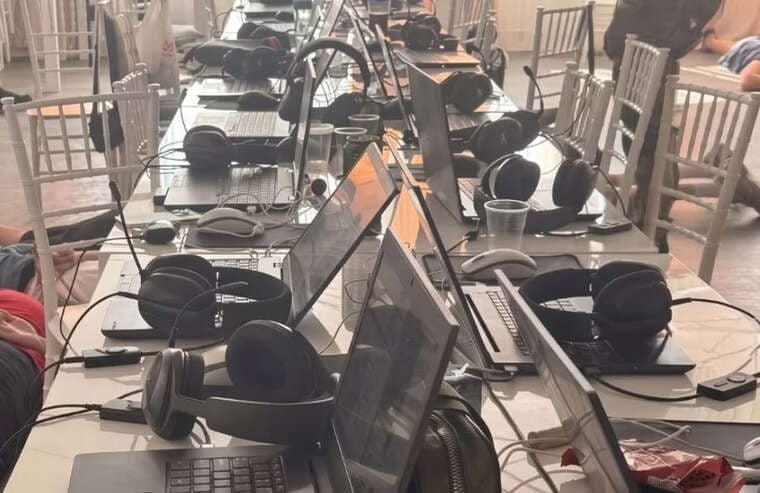
The cartel coordinated the activities of at least 52 fraudulent offices in Kyiv, Dnipro, Lviv, and Odesa. Over 2,700 employees defrauded citizens daily. Each office paid a monthly tribute of 7,000 US dollars in cryptocurrency, which was distributed among police, SBU, and prosecution units. In half a year, over 3.75 million dollars in bribes were received into one crypto wallet.
Face of the capital's "umbrella": Integration into the state apparatus
A particular danger is the depth of organised crime's integration into the repressive apparatus. State agencies were used as private special services for criminals. Public figure Oleg Symoroz emphasises that behind the conspiratorial pseudonyms stand real high-ranking officials who require immediate political accountability.
The operational pseudonym "Akim" belonged to SBU Major General Serhiy Dutsi. He provided protection for the cartel from the operational interest of colleagues, helped Osipov freely enter Volodymyrska Street, lobbied for the appointment of loyal employees, and processed fictitious documents on unfitness for military service. Detectives conducted searches at the offices of the Head of the SBU Main Directorate of Internal Security, Anton Kravchuk, and Deputy Head of the SBU Main Directorate of the DPNS, Oleksandr Kovalchuk, whose subordinates provided bandits with access to the capital's video surveillance cameras.
Police cover was maintained by employees of the Department of Strategic Investigations and the Criminal Search Department. DSI official Volodymyr Tsenov (callsign "Price") coordinated lists of protected call centres, developed instructions for returning seized equipment through manipulations with the distribution of complaints in the Pechersk District Court, and warned fraudsters about inspections. Deputy Head of the Criminal Search Department of the Kyiv Regional Police, Oleksandr Demianchuk (callsign "Consultant"), ensured safe withdrawal of fighters after attacks and reclassified contract maiming as hooliganism.
The syndicate had at its disposal a brigade of enforcers "Pasha" and "Boxer". They tracked victims for weeks through SBU cameras, then beat them with metal pipes near sports clubs under police guarantees of no "Interception" plan. Similar riots involving breaking bones with hammers occurred even in European capitals, including Vienna.
Russian trace and persecution of investigators
The most threatening aspect is the direct link of this structure with Russian special services. The head of the drug cartel, Burkin, openly discussed contacts with Russian FSB officers on recordings. This indicates the use of business by the aggressor as a tool of sabotage. Russian curators had access to the dismantling of Ukrainian power through criminal money.
When the U420 network was threatened with exposure, the syndicate moved to planning terror. Recordings captured Burkin and Osipov discussing an attack on Denys Bihus and his team: options for acid attacks, luring abroad for imprisonment, or burning property. Targets for beatings were to include blogger Ihor Lachenkov, administrators of the "Pro Kyiv" public page, and veterans who opposed drug trafficking.
Particular concern is caused by materials on the participation of high-ranking SBU officials and organised crime in attempts to discredit NABU and the Specialised Anti-Corruption Prosecutor's Office (SAPO) in the summer of 2025. The fabrication of cases against anti-corruption agency employees and the concealment of witnesses prove that the syndicate viewed independent investigation as the only real threat to its existence. Attempts by witnesses to testify were blocked under the control of General Duka.
Political accountability for this chaos cannot be limited to individual dismissals of mid-level executors. The public directly points to Deputy Head of the President's Office, Oleg Tatarov, who has long overseen the law enforcement sector, and leader of the majority faction, David Arakhamia, whose contacts with the call centre sphere have been raised in the press on multiple occasions. If the political leadership of the state does not draw comprehensive conclusions from this case, the warring country will simply be unable to expect trust from international partners and its own society.
Threat of loss of statehood and the need for cleansing
The analogy between events in the Kherson region and fresh capital materials is serious. The Kherson experiment ended with some security forces switching sides to the occupier, and the city falling under enemy control. When the law enforcement system becomes a service arm of the mafia, it loses the ability to defend sovereignty.
Today, this mechanism operates at the central level. While the military hold the enemy at the front, special services generals in the rear trade secrets, cover drug business, and order beatings of activists. Such internal rot is more dangerous than enemy information operations, as it undermines the meaning of societal resistance.
The only path to salvation is the immediate cleansing of the security block from all defendants in the recordings, regardless of rank. The "Khimprom" case must end with real prison sentences. As long as criminal figures operate freely in special services offices, words about the rule of law remain declarative.
Society is no longer ready to tolerate criminal arbitrariness. The demand for justice during the war is existential: either the state will destroy the mafia octopus within, or this octopus will bury the state itself. There is no more time for backroom deals and the imitation of reforms.



Comments
No comments yet. Be the first!