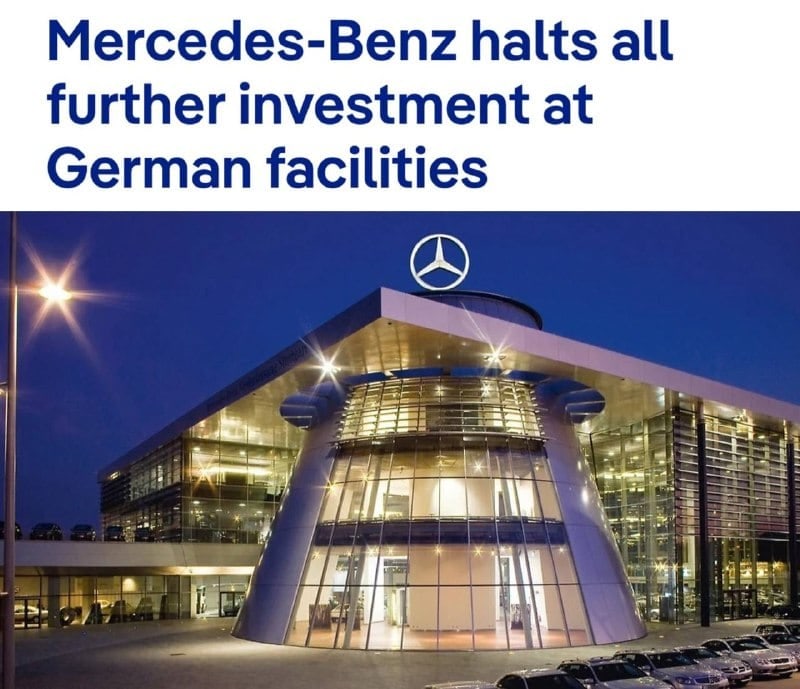
On Thursday, Mercedes-Benz announced the temporary suspension of all further investments in its German facilities. This statement came against the backdrop of increasing pressure from the works council and the IG Metall union.
Board decision and threat of production closures
This was reported in a memo on the company's internal network by board member Michael Schiebe. According to him, the management team jointly decided to suspend all investment programmes at German sites.
«The executive board has jointly decided to halt all further investments in German sites» (The executive board has jointly decided to halt all further investments in German sites), — noted Michael Schiebe in the document, which was seen by the AFP agency.
The same letter states that the company is considering the possibility of closing plants.
Financial rationale: why Germany has become too expensive
Board member Britta Seeger explained in an interview on the company's internal network that the manufacturer is forced to thoroughly check which facilities in Germany it can still afford to maintain.
«We all want to avoid plant closures at all costs» (We all want to avoid plant closures at all costs), — said Britta Seeger. — «Unfortunately, however, we must now pursue this option in more concrete terms» (Unfortunately, however, we must now pursue this option in more concrete terms).
Chief Production Officer Michael Schiebe noted that the current cost structure makes investing in Germany impossible. He recalled that he had recently announced that if production costs do not decrease, two German factories would have to be closed.
Labour costs in Germany are sometimes five times higher than at plants in Eastern Europe, where administrative costs are also significantly lower.
Causes of the crisis: China, electric vehicles, and US tariffs
Mercedes-Benz, one of the largest German brands, has been facing declining sales and profits for several years in a row.
One of the main factors is the waning demand in China — the company's largest market, which historically accounted for about a third of passenger car sales. Demand has weakened particularly for premium foreign brands, so Mercedes sales in China fell by approximately 19% in 2025.
The company invested heavily in electric vehicles, but demand for EVs in Europe and North America grew more slowly than many manufacturers expected. Meanwhile, Mercedes faces growing competition from cheaper electric vehicles imported from China.
The situation was worsened by increased US tariffs under President Donald Trump. According to Mercedes data, customs duties alone reduced the company's profit by an amount of approximately 1 billion euros (1.1 billion dollars) last year.
Similar problems are felt by several other leading German carmakers, including Volkswagen, BMW, Audi, and Porsche, as well as other European manufacturers.








Comments
No comments yet. Be the first!