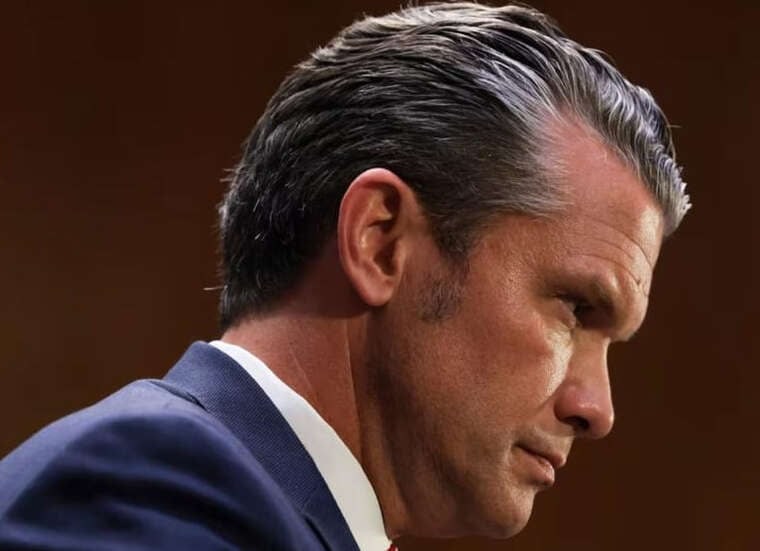
Republicans prepare impeachment of US Secretary of War Pete Hegseth over Iran conflict
A group of Republican congressmen plans to vote next week on removing Pete Hegseth from office, accusing him of poor planning in the war with Iran.
A group of Republican congressmen plans to vote next week on removing Pete Hegseth from office, accusing him of poor planning in the war with Iran.

Journalist Yuriy Nikolov revealed the content of new NABU audio recordings, which mention possible attempts to bribe officials from the Interior and Health Ministries, as well as contacts with David Arakhamia.
The Public Integrity Council found Oleksandr Andrushchenko dishonest, identifying signs of plagiarism and falsification in his academic work, as well as ethical violations in the handling of family cases.

The State Property Fund sold a stake in a sanctioned enterprise previously controlled by a Russian businessman to a company with corporate ties to a member of parliament's family.

Prime Minister Koretskyi announced that the government will transfer additional generators to the capital to support water utility operations.

Ukraine has received a new tranche of financial aid from the EU under the Ukraine Support Loan programme. The funds will be directed towards budgetary needs and defence.
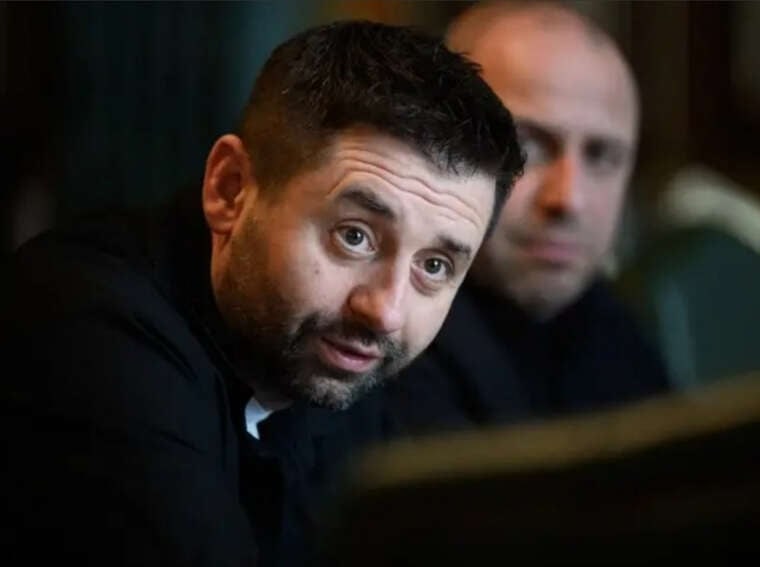
Journalist Mykhailo Tkach stated that the head of the SBU's internal security may have been appointed with the assistance of David Arakhamia, and expressed concern about the official's possible departure abroad.

Perechyn District Court in Zakarpattia forced the Bureau of Economic Security to enter data into the ERDR regarding possible tax evasion by the electric scooter network.
The Public Integrity Council (PIC) officially approved a conclusion that Oleksandr Yuriovych Andrushchenko, a judge of the Volochysk District Court in Khmelnytskyi Oblast, does not meet the criteria for professional ethics and integrity. This recommendation concerns his competition for the position of appellate court judge.
One of the key areas of concern was the analysis of cases heard by the judge regarding the determination of children's place of residence and the deprivation of parental rights. According to the PIC, between 2022 and 2025, Andrushchenko heard 16 such lawsuits. In five cases, the court granted the parents' requests to deprive mothers of their parental rights, and in two others, it determined that the child would reside with the father.
The Council drew attention to the potential link between such rulings and the possibility of obtaining a deferment from mobilisation, as raising a child independently by court order is grounds for a deferment.
In several cases, mothers acknowledged the claims and did not appear in court, while guardianship authorities supported the plaintiffs' position. Meanwhile, the court did not hear the children's opinions. Specifically, in case No. 671/304/25 (April 2025), a mother was deprived of her rights to a daughter aged approximately 15–16, even though the girl already had the right to determine her place of residence independently. In another instance (case No. 671/1860/22, February 2023), the place of residence of a 6–7-year-old child was determined to be with the father, despite the fact that she had lived with him for only a few months.
The PIC emphasises that even if the mother acknowledges the claim, the court is obliged to verify that the ruling is in the best interests of the child. Ignoring this principle raises doubts about the judge's conscientiousness.
The Public Integrity Council identified serious violations of academic integrity in Oleksandr Andrushchenko's thesis, which he defended in 2020. At least 21 fragments of plagiarism and three episodes of falsification were identified in the academic work.
In addition, approximately 29% of the sources in the bibliography were not used in the text. The Council also noted the use of Russian academic sources without critical analysis, despite the fact that the work was written during the Russian Federation's armed aggression. The PIC regards these circumstances as a systemic violation incompatible with the status of a judge.
An analysis of administrative cases revealed that the judge closed 25 proceedings on domestic violence (Article 173-2 of the Code of Administrative Offences), accounting for 10.2% of all cases of this category he heard. The grounds cited were the absence of the elements of an offence. According to the PIC, in some cases, evidence (protocols, victims' statements) was analysed insufficiently, and psychological violence was reduced to household conflicts or profanity.
Also, under Article 130 of the Code of Administrative Offences, the judge closed ten cases related to driving a vehicle while intoxicated or refusing a medical examination. The Council points to possible excessive formalism: cases were closed despite the presence of video recordings of refusals to undergo examination, positive test results, witness testimonies, or information about traffic accidents.
An additional concern was inaccuracies in the judge's declarations regarding real estate and family ties. Specifically, this concerned an apartment in Vinnytsia that Andrushchenko used free of charge. Although these facts themselves did not become grounds for a negative conclusion, the PIC considers them to require additional explanations.
The conclusion of the Public Integrity Council has been submitted to the High Qualification Commission of Judges of Ukraine for consideration during the competition for the position of appellate court judge.
Comments
No comments yet. Be the first!