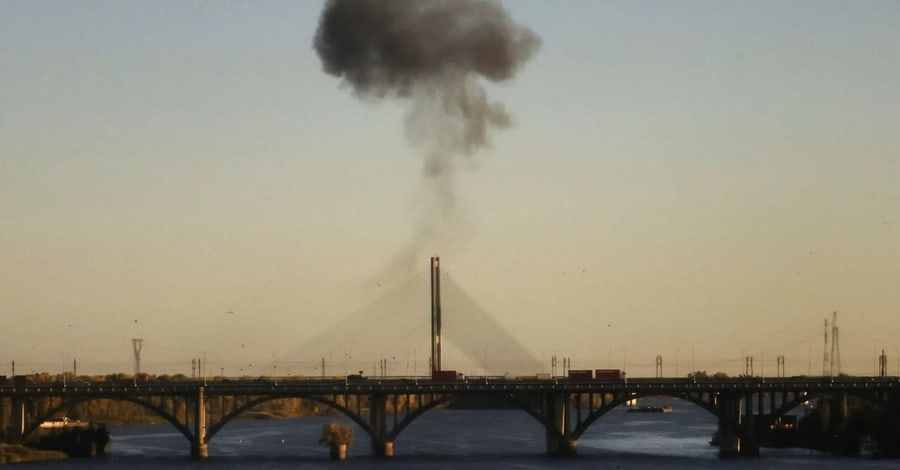
Unmanned aerial vehicles from Russia may pose a serious threat to cable-stayed bridges in Kyiv. According to Serhiy Beskrestnov, the President of Ukraine's adviser on the development of defence technology directions (callsign "Flash"), the enemy is using special shaped charge warheads designed to cut cables. Meanwhile, the anti-drone nets installed on the crossings do not guarantee full protection against such attacks.
Limits of protective structures
According to Beskrestnov, the protective structures present on the capital's bridges have significant limitations. They are unable to counter ballistic missiles, which Russian forces also use to strike the bridges.
«На жаль, ми всі розуміємо, що це неефективно» ("Unfortunately, we all understand that this is ineffective"), the President's adviser noted.
He drew attention to the fact that the nets cover only specific sections of the crossings, which casts doubt on their practical purpose. Previously, turrets and mobile fire groups were positioned next to such structures. In the expert's opinion, the nets could have served as additional protection for these air defence assets. However, after the fire support was removed, the expediency of using the nets themselves became less obvious.
Strategy for protecting crossings
Beskrestnov believes that the main task of air defence is to intercept enemy drones before they approach the bridges.
«Найкращий спосіб захисту — зробити так, щоб "Шахед" взагалі не долітав до мостів» ("The best way to protect is to ensure that the Shahed does not reach the bridges at all"), he emphasised.
Among the effective countermeasures, the adviser mentioned teams equipped with Stinger man-portable air-defence systems. However, their use requires significant resources and creates additional risks in urban areas. In particular, a drone shot down directly near the crossing could fall on residential buildings or explode.
Currently, turrets are being installed to protect infrastructure, with an effective range of approximately 1–1.5 kilometres, according to Beskrestnov. He also reported that during recent attacks, Russian forces attempted to hit not only the bridge but also the Gepard air defence system that was covering it.
Threat to cable systems
The President's adviser paid particular attention to a new type of Russian weaponry. According to him, Russia has developed a special shaped charge warhead designed to cut cables — the strong cables that support the bridge structure.
Beskrestnov claims that Russian forces have already attempted to use such weaponry and demonstrated its effect during an attack on an electricity pylon.
He noted that engineers had assessed the strength of the bridge structures and confirmed the presence of a certain safety margin. However, targeted strikes on the cables could pose a danger to the entire structure.
«Але якщо вони атакуватимуть ці ванти, то можуть зруйнувати міст» ("But if they attack these cables, they could destroy the bridge"), Beskrestnov warned.
He explained that the cable system itself could be a vulnerable element of such crossings. Meanwhile, ordinary bridges are much harder to completely destroy due to their structural safety margin. As an example, the adviser cited the Antonivskyi Bridge in Kherson, which withstood numerous strikes with various types of weaponry for a long time.
Recall that on 27 October, it was reported that the Southern Bridge in Kyiv was damaged as a result of another Russian attack. The strikes also affected the metro infrastructure, which led to restrictions on traffic across the bridge, and trains on the green metro line operated only on specific sections.




Comments
No comments yet. Be the first!