Scale of the threat: nearly a quarter of the state
As of October 2026, 132,076 square kilometres of territory in Ukraine remain potentially hazardous due to the presence of mines and unexploded ordnance. This area accounts for 21.9% of the country's total territory. The data was published on 22 October based on information from the National Mine Action Platform.
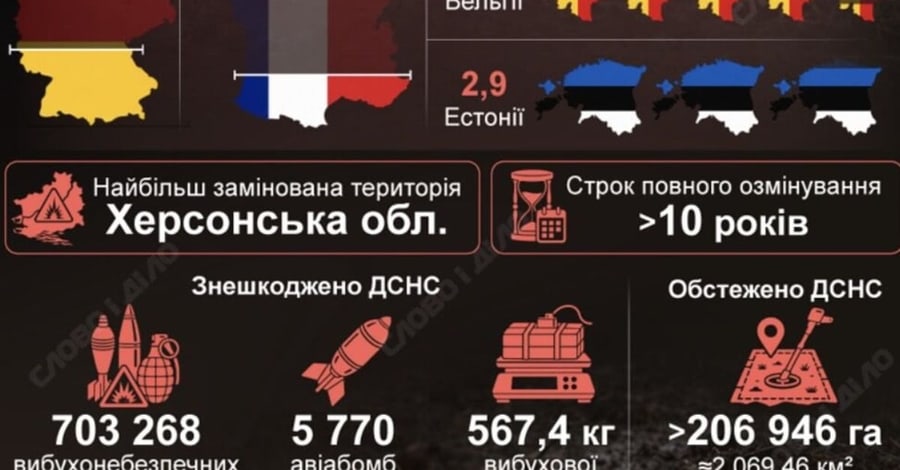
For visualisation, experts compare this figure with the sizes of other states: Ukraine's hazardous territory is approximately equal to the area of six Israels, nearly three Estonias, or over four Belgias. It also covers about 37% of Germany's territory and 24% of mainland France.
Dynamics of land clearance
Despite the significant scale of the threat, the area of potentially hazardous land has decreased substantially during the years of the full-scale war. If estimates in 2023 stood at 170–180,000 square kilometres, by 2026 this figure had dropped to 132,000.
In total, since the start of the full-scale invasion, 41,924 square kilometres have been returned to use. However, the vast majority of this land did not require direct physical demining. Specifically, 41,753 square kilometres were returned to use thanks to non-technical surveys.
This method involves a comprehensive analysis: studying data on combat operations, surveying local residents and witnesses, analysing satellite imagery, and conducting aerial inspections of territories. Based on the collected facts, specialists determine whether there are grounds to consider an area contaminated, which allows excluding from the list of hazardous zones those locations where the threat was not confirmed.
Sapper operations and the most contaminated regions
Direct physical demining, which is a significantly more complex process requiring substantial resources, has been carried out on an area of 171 square kilometres. Before returning such plots to use, specialists conduct technical surveys, determine the method of clearance, and detect and neutralise explosive hazardous objects. After the completion of work, the territory is inspected, and the results are officially confirmed.
Over the entire period of the full-scale war, Ukrainian sappers have neutralised 703,268 explosive hazardous objects, including 5,770 aerial bombs.
Kherson Oblast is considered the most contaminated by mines. There, sappers of the State Emergency Service of Ukraine made 32,442 visits. In contrast, the highest number of visits by pyrotechnic units was recorded in Kharkiv Oblast — 60,890 times since the start of the full-scale war. Both regions have been under Russian shelling for a long time, and significant territories have become sites of active combat operations.
Long-term challenges and warnings
The danger is posed not only by anti-personnel and anti-tank mines, but also by artillery shells, cluster munitions, aerial bombs, and other remnants of war. The situation remains particularly difficult on agricultural lands, where mining hinders field work.
To accelerate the process, Ukraine is increasing the number of specialised vehicles and humanitarian demining operators. At the same time, specialists emphasise that even after the cessation of active combat operations, the problem will remain relevant. According to preliminary estimates, full demining of Ukraine will require at least ten years.
Analysts note that even after large-scale clearance, it is impossible to guarantee the complete disappearance of the threat. In many European countries, explosive hazardous objects from the First and Second World Wars are still being found. Therefore, mine danger will remain one of the most serious long-term challenges, affecting the safety of the population, economic recovery, agriculture, and infrastructure.
Rescuers urge citizens not to approach suspicious objects, not to touch them, and not to attempt to move or neutralise them independently. In case of finding a potentially hazardous object, it is necessary to move to a safe distance and report it by calling 101 or 102.






Comments
No comments yet. Be the first!