Systematic appropriation of cultural heritage
Since the annexation of Crimea in 2014, the Russian Federation has implemented its own system for the protection of monuments on the peninsula. The Ukrainian side ceased issuing excavation permits, but Russian scientific institutes and museums continued their work, obtaining legalisation from the Russian Ministry of Culture. According to the Main Directorate of Intelligence (GUR), between 2014 and 2023, Russian institutions received permits for archaeological work in occupied Crimea. The artefacts found were systematically transferred to the collections of Moscow-controlled institutions, accompanied by a change in their legal status.
Kerch: excavations without coordination with Ukraine
One of the key sites became Myrmekion, an ancient settlement in present-day Kerch, a monument of national significance. The expedition there was led by Oleksandr Butyagin, head of the Department of Ancient Archaeology of the Northern Black Sea Region at the State Hermitage Museum. Despite the fact that he worked legally and collaborated with Ukrainian colleagues prior to 2014, he was not issued permits by the Ukrainian Ministry of Culture after the occupation. According to GUR materials, Butyagin headed work at the monument at least in 2014–2018 and 2021–2023.
In August 2022, the expedition discovered a hoard: 30 gold coins were found in a clay jug, of which 26 bore the image of Alexander the Great, and four — his brother Philip III Arrhidaeus. According to Suspilne, the value of the find was estimated at over 8.5 million hryvnias, after which the artefacts were taken to the Russian Federation. GUR included the coins in the list of appropriated cultural heritage. A criminal case has been opened against Butyagin: initially for illegal search work, and in 2026, suspicion of violating the laws and customs of war was added.
A similar situation has arisen at other Kerch monuments — Nymphaion and Panticapaeum. After 2014, at least 164 items were moved from there, including ceramics, metal and bone products. Employees of the Hermitage and the Russian Academy of Sciences worked at Nymphaion, while the Pushkin State Museum of Fine Arts, under the leadership of Volodymyr Tolstikov, worked at Panticapaeum, who regularly received permits from the Russian Ministry of Culture.
"New Chersonesus" and the threat to a UNESCO site
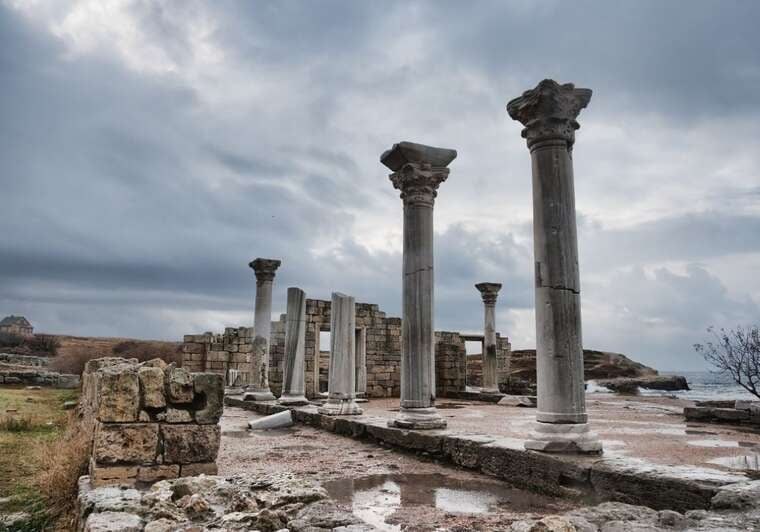
The most extensive transformations took place in Chersonesus Taurica (Sevastopol), which, together with its buffer zone, is included in the UNESCO World Heritage List. After the occupation, new archaeological and construction works began there, and later the "New Chersonesus" complex appeared nearby. According to materials submitted by Ukraine to UNESCO in 2026, the development covered approximately 24 hectares, and the area of the new buildings is approximately 40,000 square metres.
Part of the construction work was carried out on the territory of the ancient city and necropolis. The Ukrainian side reported the use of heavy machinery, which could have damaged the archaeological layer. Russian archaeologists excavated individual plots before development, after which new objects were built in their place. These works were not coordinated with Ukraine, and UNESCO did not receive prior notification of the changes.
Expansion of the practice to eastern and southern Ukraine
After 24 February 2022, the mechanism for issuing excavation permits was extended to other occupied regions. According to the Regional Centre for Human Rights, from January to May 2026 alone, Russian institutions issued at least 56 permits for work in Crimea and 11 — in the occupied parts of Donetsk, Luhansk, Zaporizhzhia and Kherson regions.
Among the archaeologists working in these territories, GUR names Eduard Kravchenko. He led expeditions in the Donetsk region even before the full-scale invasion. In September 2024, Kravchenko received a permit for work in the occupied parts of Donetsk and Zaporizhzhia regions, and in 2025–2026 — new permits for Crimea.
Another example is Oleksandr Kolesnyk, who received three permits for work in occupied Donetsk region in 2024–2025. He heads the project "Archaeology of new territories: from Donetsk to Krasnoyarsk", which is funded by the Russian Presidential Grants Foundation. The project's goal is to promote the narrative of Donbas as part of "historical Russia".
Students are also involved in the process. Professor at the so-called "Donetsk State University", Larysa Shepko, coordinates student participation in archaeological practices in occupied territories. Some internships are conducted with the participation of the "Chersonesus Taurica" museum-reserve. Thus, a new generation of specialists is being drawn into the Russian professional environment, for whom the subordination of Ukrainian monuments to Russian museums becomes the norm.
Integration of finds into the Russian museum system
Finds from occupied territories are recorded in the Russian museum system. According to the War&Sanctions portal, the "Donetsk Republican Local History Museum" and the "Luhansk Local History Museum" participated in the work. Items receive inventory numbers of Russian institutions, are described according to their rules, and are used in exhibitions and scientific publications as part of the Russian collection. This allows the Russian Federation to claim the right to store and present these artefacts to the public.
"Kamianka Mohyla" near Melitopol also came under Russian control — a unique monument with thousands of petroglyphs. Together with the object, Russia gained access to the reserve's collections. Some items from these collections have been included by GUR in the list of appropriated cultural heritage, where "Kamianka Mohyla" is listed alongside finds from Crimean necropolises and items from the Novokakhovka City Art Gallery.
Legal aspect and personal responsibility
In accordance with the 1954 Hague Convention, the occupying power is obliged to facilitate the preservation of cultural values and cooperate with the competent authorities of the occupied state. International law prohibits the theft, looting and illegal export of monuments. Permits from the Russian Ministry of Culture do not change the legal status of the territory and do not give the Russian Federation the authority to dispose of Ukrainian heritage.
The Second Protocol of 1999 to the Hague Convention allows excavations in occupied territory only for the preservation, documentation or protection of values. Since Ukraine is a party to this protocol, and Russia is not, the assessment of the Russian Federation's actions is also based on general rules of occupation and the prohibition of appropriation.
The personal responsibility of archaeologists depends on their role. Expedition leaders who receive permits, define plots and organise the removal of finds bear greater responsibility than students or laboratory assistants. In the case of Oleksandr Butyagin, the investigation is examining the scale of the excavations, changes in the monument's territory, and the fate of the finds. Butyagin himself does not admit guilt, while his Russian colleagues claim that the expedition was engaged in the study and preservation of the monument.
Archaeology as a tool of historical policy
Russia uses archaeological materials to form its own narrative about the past of Crimea, Donetsk, Luhansk and Zaporizhzhia regions. In 2024, the "New Chersonesus" complex was opened in Sevastopol, one of the central institutions of which became the Museum of Crimea and Novorossia, with an area of approximately 12,000 square metres. The project was created on the instruction of Volodymyr Putin. Russian sources present Chersonesus primarily through the prism of the baptism of Prince Volodymyr, while the monument covers a much wider ancient and Byzantine period.
In September 2023, the multimedia parks "Russia — My History" opened in occupied Luhansk and Melitopol. The exhibition in Luhansk is dedicated to the history of Donbas from Ancient Rus to the present, emphasising the unity of "Novorossia" and Russia. A similar park appeared in occupied Donetsk in 2026, where the history of the region begins with the Cossacks, and Donbas is presented as an industrial centre of Russia.
Archaeologist Gert Jan Plets from Utrecht University notes in a 2026 study that after the occupation of Crimea, Russia selectively reinforces themes that demonstrate historical continuity between the peninsula and the Russian Federation. For Chersonesus, such a theme became the baptism of Prince Volodymyr, and for eastern and southern Ukraine — the concept of "Novorossia". Plets also notes the appearance of branches of the Russian Geographical Society and the integration of local institutions into all-Russian scientific networks. Thus, Russia is not only taking physical artefacts, but also trying to monopolise the right to explain the past of these territories.
Comments
No comments yet. Be the first!