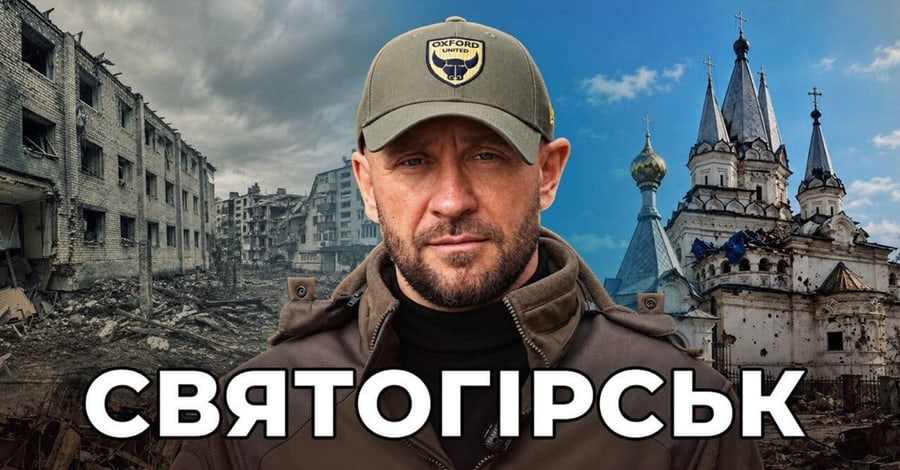
A year ago, families with children would come here. Today, in Sviatohirsk, one hears mainly generators and drones. Journalist and volunteer Roman Bochkala visited the city and shot a film about it in IMAX format. It shows logistics, the daily routine of locals, the work of volunteers, and the main question: is it possible to rebuild Sviatohirsk.
Entry conditions and road safety
Getting to Sviatohirsk is currently extremely difficult. Any trip requires coordination with the military, and the city military administration must be notified in advance. The journalist reached the city only under escort and with technical cover.
Movement takes place at a speed of 150–170 km/h. According to the escorts, enemy drones pierce through protective nets, so stopping means death. A kill zone was set up along the riverbank, although the front line, according to them, has already shifted.
Changes in the urban environment
The central tourist street, which Bochkala calls the "Sviatohirsk Broadway," was once popular with holidaymakers. Now a "Buying drones" sign hangs on it, symbolising the new reality. The author notes that the contrast with his visit a year ago is striking: then the city lived a full life, but now the streets are empty, and an over-a-century-old Ukrainian school did not survive the Russian "liberation".
One local resident recalls that Sviatohirsk was a wealthy resort for all of Donbas and Ukraine. Now few people remain. When asked about heating and light without windows, the answer is simple: there are torches and candles. Those who remained consciously chose to live here.
Everyday life and community support
Life in the city depends on generators: where technical equipment works, there is heat and light. The shop is holding on, but the range is limited. The most popular items are sugar and sweets; the sausages were bought out. The shop assistant, who once worked at Nova Poshta, moved here and stayed. She says she is happy with every customer. Bochkala emphasises that it is people like these who keep the community going.
The situation in Lyman
Neighbouring Lyman had it significantly worse. Residents report that Russians destroyed nine-storey buildings with three-metre aerial bombs: a building hit by such a bomb simply collapses. Operation Vivaldi allowed the city to be unblocked. Over the course of a month, approximately 70–80 people emerged from there, who had been cut off from the world for eight months.
According to estimates by residents of the northern part, about 15% of Lyman remains. Going outside is impossible even at night; even lighting cigarettes is forbidden. The dead are buried in courtyards. One story concerns a 75-year-old woman buried near a house. A resident sums up: "There are more drones than birds".
Refutation of Russian claims
A separate episode of the film is dedicated to Russian propaganda. A couple of months ago, the Russian Federation claimed that the city, which their media call "Sviatogorsk", has allegedly been under Russian control since 1 September. Bochkala recalls Vladimir Putin's statement that Sviatohirsk is "theirs". The response was visual: on 2 September 2026, the head of the Sviatohirsk city military administration, Volodymyr Rybalkin, recorded a video on Ivan Mazepa Street in the city centre. Above him is the Ukrainian sky, and Ukrainian flags hang on the buildings.
Rybalkin notes that this once again proves Russia's intention to capture the city. In the conversation, it is mentioned that there are three lavras in Ukraine (Sviatohirsk, Kyiv-Pechersk, and Pochayiv), while there are only two in Russia.
Historical significance of the Lavra
The Sviatohirsk Lavra, an active male monastery and one of the main shrines of Orthodoxy, makes the city unique. The history of the monastery includes periods when it effectively ceased to exist. A monastery resident recalls the times of Empress Catherine, who secularised monastic lands and closed many monasteries, not understanding the meaning of monasticism.
The chalk caves of the lavra, according to historians and archaeologists, were dug out as early as the 9th century, before the Baptism of Rus. The monastery considers it likely that Cyril and Methodius were here, as they preached in Khazaria, and one of the Khazar cities was found nearby. Today, the length of the caves is about 900 metres, although they were once longer. Part of the hill was cut off during the construction of the Assumption Cathedral, and the Church of Saint Nicholas on the rock was previously also a cave church. Memory of the tradition of a cross procession on boats has been preserved: in certain years, more than a hundred vessels went out onto the water.
Aid and reconstruction prospects
The city also cares for stray animals: a local caretaker looks after about a hundred dogs. In winter, she feeds them mainly porridge, and four buckets are used for this every day. Roman Bochkala calls on those willing to help to come not with empty hands, as volunteers always bring what is needed.
As the author notes, Sviatohirsk can be rebuilt very quickly. Roads, utilities, and, most importantly, people have survived. Residents who still live in the city believe in themselves, the Armed Forces of Ukraine, and that Sviatohirsk stands.




Comments
No comments yet. Be the first!