Done's Schemes: How Ukrainian Hryvnia Turns into Swiss Francs via Importers
Investigation reveals a network of companies where funds are collected in Ukraine, converted into foreign currency, and transferred to Swiss Done Switzerland AG.
Investigation reveals a network of companies where funds are collected in Ukraine, converted into foreign currency, and transferred to Swiss Done Switzerland AG.

Taras Vysotsky stated that alternative logistics corridors provide only 45% of the required volumes, threatening the loss of a significant portion of the harvest.
Lead State Prosecutor Taavi Pern confirmed that the activist was aware of the criminal liability for his actions, having contacted individuals who already had convictions for similar offences.
Investigators uncovered a scheme for the misappropriation of military property organised by the deputy commander of the unit. The process was later overseen by an SBU counter-intelligence officer assigned to the unit.
A representative of the ATB chain dispelled rumours about warehouse destruction, explaining that the buckwheat shortage is due to the cessation of supplies, while the disappearance of sugar is temporary.

European experts warn that restrictions on US diesel exports could become a trigger for a historic rise in prices on the continent.
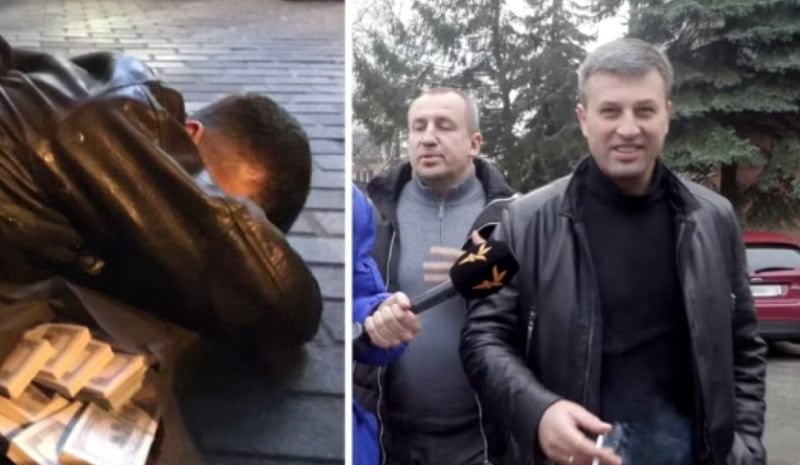
Shevchenkivskyi District Court of Kyiv found two former prosecutors not guilty of demanding $150,000 to close a case.
Investigation revealed that custodian company Trustee Plus has legally ceased to exist, while customers face fund blocking under the pretext of audits.
Ukrainians are increasingly turning to microcredit organisations that promise "quick money". However, behind the attractive simplicity lie exorbitant interest rates that turn borrowers into debtors. For many, financial dependence becomes an unbearable burden, and in some cases, a threat to national security.
According to law enforcement data, borrowers with large debts are often drawn into criminal schemes. Recently, there has been an increase in cases of arson targeting military vehicles in Ukraine, with perpetrators including individuals forced to pay off microloans. Some of them, in desperation, agree to commit crimes in exchange for small sums of money.
Serviceman Taras Kotov said he became a victim of such an attack: "Проснулся ночью от шума, увидел пожарных и полицию. Моё авто уже потушили. Оказалось, что его пытались поджечь" (I woke up at night to the noise, saw firefighters and police. My car had already been extinguished. It turned out that they had tried to set it on fire). It later emerged that the arsonists were a woman and her minor son, both of whom were in debt due to microloans.
According to Dmytro Vlasov, a representative of the Kyiv City Prosecutor's Office, the criminals had another similar incident. The arsons were organised via Telegram, where coordinators indicated potential targets, leaving the choice of vehicle to the discretion of the perpetrators. The woman now faces up to 10 years in prison, and her son up to seven.
With the start of Russia's full-scale invasion, the number of clients of microfinance organisations increased sharply. Financial analyst Serhiy Fursa explains that high interest rates drive people into a debt spiral, forcing them to take out new loans to pay off old ones.
In addition, borrowers hand over their personal data to creditors, creating an additional risk: information about financially vulnerable citizens could fall into the hands of the occupiers and be used for recruitment.
Journalists discovered that a network of microcredit organisations operating across Ukraine is owned by a family with close ties to Russia. Among them is the company "Prosto Pozika", founded in 2014 and having dozens of branches across the country.
Formally, the owners are Ukrainian citizens, however, the investigation showed that the key figure, Andrey Manucharov, obtained Russian citizenship in 2014. Prior to this, he held senior positions in Ukrainian state structures, and then moved to work in Russian agencies, including "Rosmorport".
His son, Ivan Manucharov, is a deputy of the occupied parliament of Crimea from "United Russia" and actively supports Russian aggression. The businessman's wife, Natalya, also obtained Russian citizenship and manages another microcredit company in Ukraine.
In 2022, the National Bank of Ukraine banned Russian citizens from managing financial institutions in the country. However, the licences of the companies "Prosto Pozika" and "Time Credit" were extended without restrictions. Official documents do not contain information about the owners' Russian citizenship, which allowed them to continue their activities.
Following the journalists' investigation, the National Bank stated that it would send requests to law enforcement agencies to verify the information. If the owners' Russian citizenship is confirmed, the companies may lose their licences.
Andrey Manucharov left Ukraine in December 2021 and, according to journalists, lives in Turkey. In 2020, he purchased a 27-metre yacht worth $2.7 million, on which his family went on holiday in early 2022, shortly before the invasion.
In response to journalists' questions about his Russian citizenship and the microcredit business, Manucharov answered briefly: "Глупости какие-то говорите" (You are saying some nonsense). However, the investigation points to the opposite: his companies continue to operate despite the bans, and Ukrainians who find themselves in debt become not only victims of financial schemes but also instruments of criminal plots.
Comments
No comments yet. Be the first!