Striking oil refining facilities in Samara region
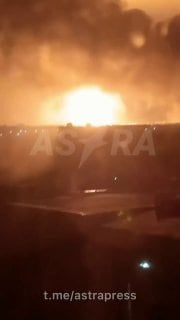
Ukrainian attack drones struck the Syzran and Kuybyshev refineries of the company "Rosneft", located in Samara region. The total annual capacity of these facilities is approximately 16 million tonnes. A possible strike on the Samara Linear-Node Dispatch Station (LVDS) is also mentioned, although there is currently no visual confirmation of these damages.
The Syzran refinery, located 800 km from the border, has an annual processing capacity of 8.5 to 8.9 million tonnes of oil. The region's governor confirmed damage to the facility, but details have not yet been disclosed. According to open sources and monitoring channels, a large-scale fire broke out at the plant. A preliminary strike on this facility took place on 15 September, when the General Staff of the Armed Forces of Ukraine confirmed the hit on the AVT-6 unit and the tank farm. If primary processing was hit, each day of downtime means a loss of approximately 24,000 tonnes of oil that will not be converted into fuel.
The Kuybyshev refinery in Samara, which processes about 7 million tonnes per year and operates primarily for the domestic market, was also struck. On 22 September, tanks at this plant were already on fire. The extent of the damage is currently being assessed.
The Samara LVDS in the settlement of Prosvit is the largest oil hub of Transneft. The facility covers an area of 216 hectares and houses 71 tanks with a total capacity of 1.6 million cubic metres. Four main oil pipelines from Western Siberia, Tatarstan, Orenburg region, and Kazakhstan converge here. The facility had already been struck in October-November; on 8 October, tanks with a capacity of approximately 170,000 tonnes burned out.
The Novokuybyshev refinery in Samara region is also mentioned. According to Kyiv Post, this Rosneft plant has already been shut down, as oil processing was suspended after previous strikes.
State of the Russian oil refining industry
Since the beginning of November, the Armed Forces of Ukraine have struck 16 Russian oil refineries. Since the beginning of 2026, more than 110 strikes on oil refining facilities have been recorded. The Institute for the Study of War (ISW) estimates the decline in processing volumes in Russia since late October at approximately 30%. Industry sources for Reuters report a 45% reduction in the first three weeks of November.
On 24 November, Vladimir Putin acknowledged that the situation in the domestic fuel market is "difficult". He called on oil companies to develop refining capacities in Siberia and the Far East, i.e. in regions that are further from the reach of Ukrainian drones.
Oil prices also affect the Russian budget. The Brent grade is holding at $89–91 per barrel (a three-month low), while Urals is around $70. The combination of cheaper raw materials and reduced refining capacity is hitting the Kremlin's finances from two sides.
Military industry and international cooperation
Ukraine and Germany have started joint production of reconnaissance drones. Khmara and Pistorius signed an agreement in Berlin to establish a joint venture in Germany. The plan for 2027 provides for the production of several thousand tactical reconnaissance UAVs for the Armed Forces of Ukraine at the expense of German funds. This is already the 12th joint production project between the countries and the sixth specifically with Germany.
The Ukrainian combat system DELTA is entering the export market. Germany became the first country to gain access to this system, followed by Norway, where the agreement was signed in Oslo. Combat and operational data obtained in Ukraine will not be transferred to partners.
Blocking of Patriot missile supply
The supply of 48 missiles for Patriot air defence systems, which have already been paid for by allies through the PURL programme, is still awaiting the signature of US Secretary of Defense Pete Hegseth. Licences for the production of PAC-2 and PAC-3 missiles in Ukraine are also absent, and restrictions on the use of Starshield remain in force.
Other international and frontline events
Peace process specialists Witkoff and Kushner are seeking to reach an agreement by January. If the peace track fails, Kyiv will turn to the new composition of the US Congress for help and the introduction of new sanctions.
Norway plans to allocate at least $7 billion for 2027. Bilateral aid will be directed primarily to air defence and unmanned systems. The parties discussed the supply of interceptor missiles, the integration of new missiles into the NASAMS system, and the provision of additional fighter jets.
On the frontline, the General Staff of the Armed Forces of Ukraine confirmed the destruction of a river crossing over the Vovcha River in the area of Novoukrainka (Donetsk region, TOT zone). This crossing was used by the occupiers to transport personnel and equipment. Now their logistics has become longer and more vulnerable.
The destruction of a concentration of Russian army trucks near Berestek (Bryansk region) has also been confirmed. This resulted in the loss of transport for delivering troops and equipment; exact losses are being clarified.






Comments
No comments yet. Be the first!