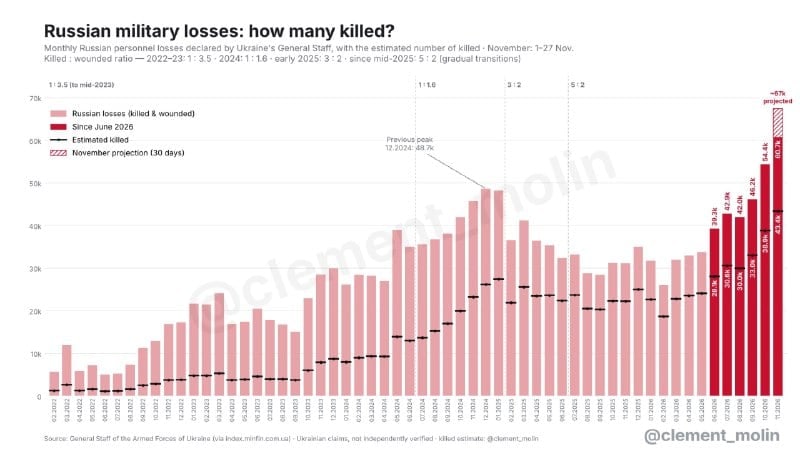
Clément Mollien has published a detailed visualisation of the dynamics of Russian losses in the war against Ukraine. The key aspect of this data is not the absolute figures, which are already known, but the fundamental change in the structure of losses: the ratio between killed and wounded has undergone significant changes over several years.
Change in the structure of losses
According to the provided data, in 2022–2023, there were 3.5 wounded for every one killed Russian serviceman. By 2024, this indicator had dropped to 1.6 wounded per one killed. The situation intensified in early 2025, when the ratio became 3 killed to 2 wounded. By the end of 2025 and in 2026, a level of 3 killed to 1–1.5 wounded is observed.
Thus, if at the start of the full-scale invasion there were three times as many wounded as killed, the situation has now reversed: more Russians are being killed than wounded.
Methodology verification
Mollien himself notes that such indicators may seem extreme. However, the analyst has confirmed the reliability of his methodology. He explains that until July 2025, estimates obtained by applying a variable killed-to-wounded coefficient to the data of the General Staff of the Armed Forces of Ukraine have been well aligned with the official statistics of Rosstat, as well as with the data from the "Mediizona" project.
To understand the scale of the problem, it is worth noting that in November 2026, the Ukrainian army reported the highest level of Russian losses since the start of the war. According to official data, which likely contain exaggerations, more than 60,000 Russian servicemen were put out of action this month. This figure is corroborated by data from the Unmanned Systems Forces, which independently reported putting 18,000 Russian soldiers out of action in a month — a record result since the establishment of this branch of the military.
The "Alpha" unit of the SBU has been particularly active: over the past week, it reportedly eliminated approximately 5,000 Russian servicemen, of whom 67% were killed. This unit has led the "Delta" ranking, which ranks units based on combat results, for over eight consecutive months.
Trends and forecasts
Mollien emphasises that Russian losses have risen sharply since June, which is confirmed by official figures, verified data from specific units, and frontline contact reports. In his opinion, the main question is not the unverified figures themselves, but why the trend is changing and how long Russia can sustain such a pace of losses. It is important to determine how much current Ukrainian data is exaggerated and how the Russian army is compensating for these losses.


Comments
No comments yet. Be the first!