Court verdict on disclosure of deployment data
The Soloniansk District Court in Dnipropetrovsk region handed down a verdict against serviceman Roman Burchyn. The master sergeant of a drone company (BpAK) in one of the military units was found guilty of illegally disseminating information about the location of a unit of the Armed Forces of Ukraine. The court sentenced him to five years of imprisonment.
Timeline of events and consequences
According to the case details, in March the defendant was corresponding on Telegram with an unidentified person. During the conversation, he provided them with the coordinates of his unit's location. Five days after sharing this data, the position was attacked by a "Geran-2" drone. The strike destroyed residential and technical structures, and four servicemen were injured.
Following the incident, the unit changed its deployment location. However, on 23 March, Burchyn sent new coordinates to another person via messenger. On 26 March, this position was also attacked by unmanned aerial vehicles.
Defendant's version: unintentionality and "volunteers"
Roman Burchyn did not deny the fact of sharing coordinates, but claimed he acted unintentionally and through negligence. He explained that he was communicating with women who presented themselves as volunteers, with the aim of getting acquainted and discussing possible assistance to the unit, specifically the purchase of mattresses and civilian clothing. The serviceman emphasised that he had no intention of putting himself and his comrades in danger and perceived the drone strikes as a coincidental set of circumstances, not linking them to his conversations.
It was only after the second attack, when Security Service of Ukraine (SBU) officers arrived at the scene, that Burchyn understood the seriousness of the situation and voluntarily offered to have his smartphone with the correspondence checked.
Details from the correspondence
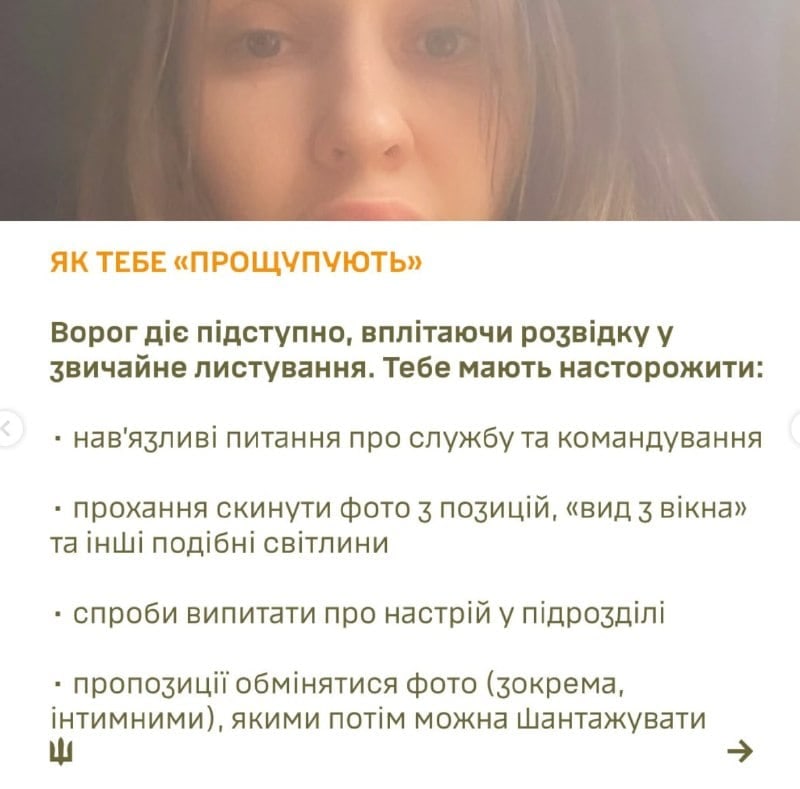
An analysis of the chats showed that the interlocutors communicated primarily in Russian. They presented themselves as volunteers distributing humanitarian aid and asked about the unit's needs. Meanwhile, the soldier replied that everything necessary was available and tried to steer the conversation in a personal direction.
Despite this, the "girls" insisted on the exact location, justifying it with a desire to visit for a personal meeting. Initially, the soldier refused, but when one of the interlocutors stated that she was already on her way to him, he sent a geo-tag. On 18 March, Burchyn informed her that a drone had hit his hut the previous day, and the interlocutor asked him to send photos or videos of the strike's aftermath.
On 23 March, in a dialogue with another person, the man again confirmed his status as a serviceman and reported the unit's relocation due to the previous hit. The "girl" claimed she had previously visited this village as a volunteer. In response to her question about safety, Burchyn replied that it was calm there and invited her to come. After this, he sent a screenshot of Google Maps with coordinates. On 26 March, two "Geran" drone strikes were carried out on this location.
Court's position
The court rejected the defendant's version that he acted with the aim of obtaining volunteer assistance. As evident from the case materials, the communication had a personal nature. The question of assistance arose only after an enemy UAV hit the unit's building, and the "volunteer" attempted to obtain confirmation of the strike's consequences.
The court also noted that Burchyn was aware of the consequences of his actions. Initially, he only provided the settlement name and landmarks, refusing to give precise data, which indicates an understanding of the risks of revealing military geolocation.
Circumstances of the case
It was established that the convicted man is married, has a disabled child and a pensioner mother. At his place of service, he was characterised well. Despite this, the court found him guilty of committing a crime and sentenced him to five years of imprisonment.





Comments
No comments yet. Be the first!