The Russian government has officially approved the creation of an alternative maritime corridor for supplying the Kaliningrad region. To implement this plan, which is to be completed by 2030, 46.95 billion rubles will be allocated. The main objective of the project is to minimise the risks of complete transport isolation of the Russian exclave due to restrictions on land transit through the territories of European Union countries.
Prime Minister of the Russian Federation Mikhail Mishustin announced these intentions on 23 November during a meeting with his deputies. Details of the project are confirmed by a government decree dated 6 November 2026, No. 3227-r, published on the official website of the Russian cabinet of ministers.
Financing and ship production
The total cost of constructing two new rail ferries is 46.95 billion rubles. According to the financial plan, 38.1 billion rubles will be directed from the Russian National Wealth Fund, while the remainder, approximately 8.85 billion rubles, will be covered by the federal budget.
The state enterprise Rosmorport acts as the client and future owner of the vessels. The shipyard named after Butoma, located in occupied Crimea (Kerch city), has been designated as the contractor. Thus, part of the funds for the Russian state project is planned to be directed to production in the temporarily occupied Ukrainian region. The construction period covers the years from 2026 to 2030.
The new vessels are to serve the maritime crossing between the port of Ust-Luga (Leningrad Oblast) and Baltiysk (Kaliningrad Oblast). This route will allow cargo to be delivered without passing through the land territories of Lithuania and other European states.
Logistics scenarios and blockade threats
In the project's investment passport, Russian authorities analysed possible changes in cargo flows. According to the baseline forecast for 2031, the total volume of transport between the mainland Russian Federation and Kaliningrad may amount to 6.8 million tonnes per year. Under normal conditions, approximately 2 million tonnes are planned to be transported via the Ust-Luga – Baltiysk maritime crossing.
However, in the scenario of a complete cessation of land connections, the need for maritime transport may rise to 6.8 million tonnes annually. The document also notes that the gradual introduction of EU sanctions complicates rail transport. Furthermore, by 2030, the Russian Federation plans to decommission two existing ferries – the Baltiysk and the Ambal, so the new vessels must compensate not only for a potential blockade but also for the reduction of the existing fleet.
Strategic significance of the region and NATO reaction
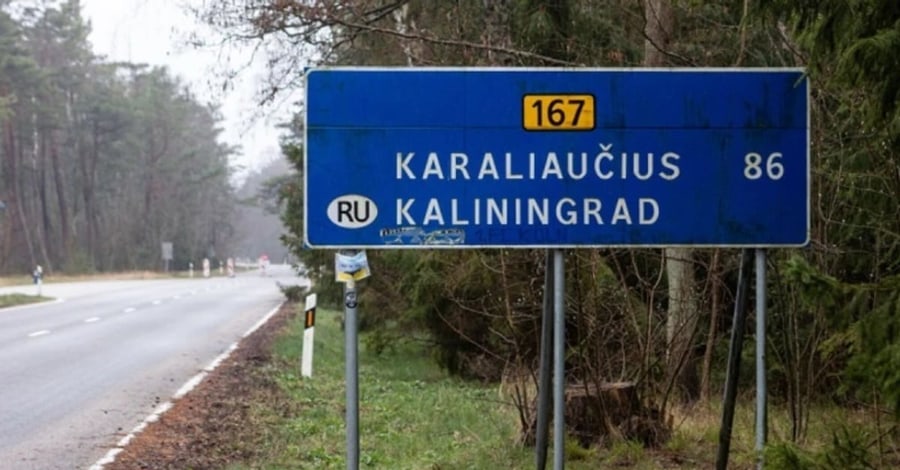
The Kaliningrad region, located on the Baltic Sea coast between Poland and Lithuania, does not share a land border with the mainland Russian Federation. This makes the supply of the region dependent on maritime routes and transit through neighbouring states. Since the full-scale invasion of Ukraine in 2022, the issue of transit has repeatedly become a subject of disputes between Moscow and Europe. In particular, Lithuania introduced restrictions on the transport of certain sanctioned goods in accordance with EU decisions, to which Russia responded with accusations of attempts to isolate Kaliningrad. However, restrictions on the transit of sanctioned products do not imply a complete transport blockade of the region.
It is worth noting that Kaliningrad is an important military district of Russia, where facilities of the Baltic Fleet, military aviation, and air defence systems are located. The announcement of plans for ferry construction comes against the backdrop of escalating relations between the Russian Federation and NATO. In September 2026, Russian representatives threatened a nuclear response in the event of a blockade of Kaliningrad by Alliance forces. In turn, NATO officials had previously discussed possible actions against military infrastructure in Kaliningrad in the case of Russian aggression against Alliance states, including the neutralisation of air defence systems.
On 23 November, Kremlin spokesman Dmitry Peskov stated about dangerous, in his words, terrorist activity in the Baltic Sea area, without providing specific evidence. However, the published documents do not confirm that NATO plans a blockade of the region or that Moscow has information about the preparation of such a decision. Investments in maritime logistics indicate the Russian government's desire to reduce the Kaliningrad region's dependence on land transit.
It was previously reported that Lithuania is strengthening the protection of a key substation near the Kaliningrad region, taking measures to counter possible drone attacks and sabotage at critical infrastructure facilities.






Comments
No comments yet. Be the first!