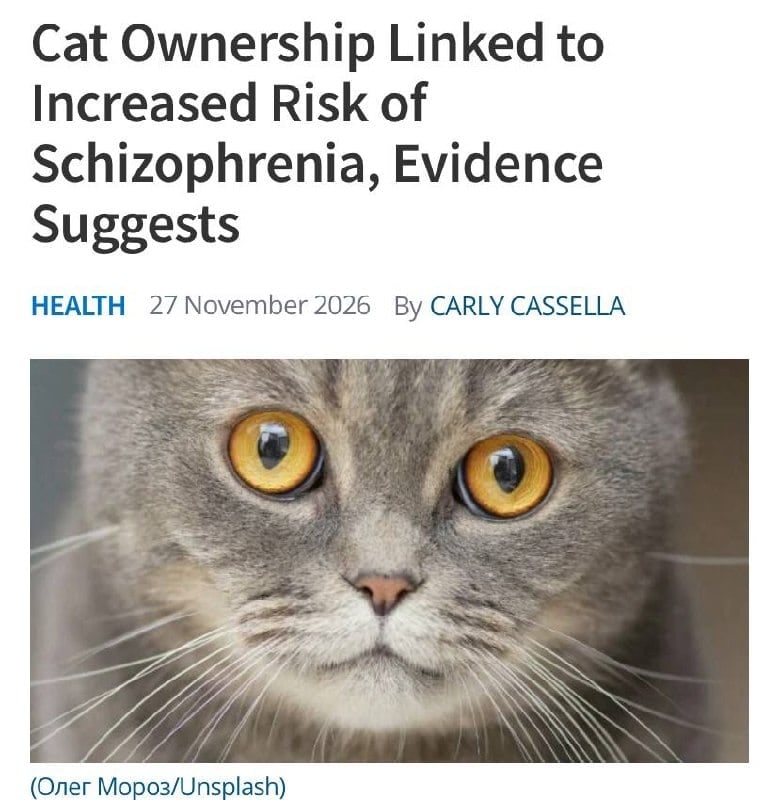
Study indicates increased schizophrenia risk in cat owners
Meta-analysis of 17 scientific papers found a correlation between childhood contact with cats and the development of a mental disorder.
Meta-analysis of 17 scientific papers found a correlation between childhood contact with cats and the development of a mental disorder.

Cyberattack on key US Air Force infrastructure threatens tactical and personnel data. Cyber Command has been involved in the investigation.

So-called head of the drifters' organisation Maxim Miller explained in December 2022 that due to his health condition, he could not defend the state with a weapon, so he chose volunteering, but is currently resting abroad.

One person died in the accident involving the vessel owned by a Turkish company, while 16 other crew members were rescued.

Over ten years of work by anti-corruption bodies, cases involving 1,661 defendants have been sent to court. Of these, 484 individuals received legally binding verdicts, while only a third of the convicted received actual deprivation of liberty.

Sergiy Prituli's charitable organisation handed over a multi-purpose boat, designed specifically for operations in open waters, to an intelligence special unit.

The wedding of Anant Singh's daughter turned into a mass celebration featuring a 151-car convoy, 500 chefs, and multi-kilometre traffic jams.

Presidential adviser Serhiy Beskrestnov reported on the active use of new technology from Chinese developers by Russian forces.
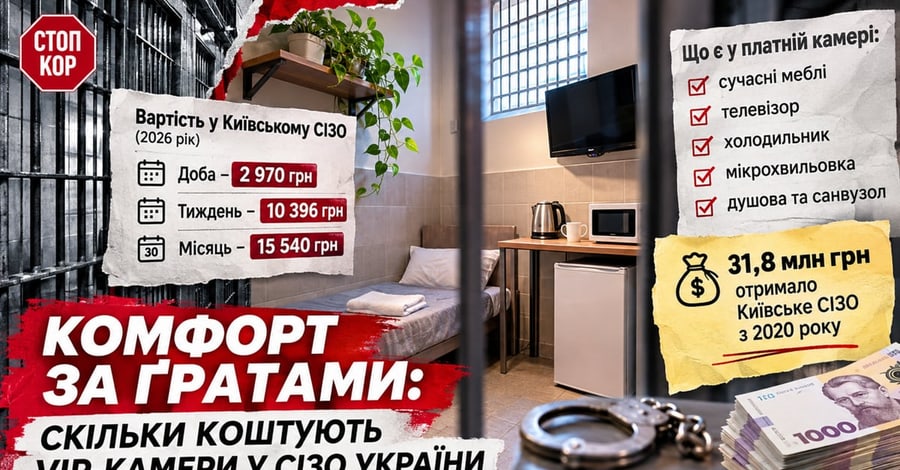
In 2026, staying in cells with improved living conditions in Ukrainian pre-trial detention centres (pre-trial detention centres) can cost between 450 and 2,970 hryvnia per day. The highest rates apply in the capital, where a month's stay costs more than 15,000 hryvnia. In the six years since the project's inception, the Kyiv Pre-trial Detention Centre alone has earned over 31 million hryvnia.
The material is based on official responses from the Ministry of Justice, the State Penitentiary Service, and the administration of the Kyiv Pre-trial Detention Centre, provided in response to requests from journalists of the publications "Glavkom" and "Politerena".
The service providing cells with improved detention conditions appeared in May 2020. The first four such premises were opened in the Lukianivka Pre-trial Detention Centre in Kyiv, after which the practice was extended to other regions. The initiator of the innovation was the then Minister of Justice, Denys Malyska.
The main goal was to reduce the level of corruption in penitentiary institutions and create an additional source of funding. Instead of unofficial fees, a legal payment mechanism was introduced. The funds from it were to be directed to a special budget fund and used, among other things, for the repair of ordinary cells.
As of June 2026, 88 cells with improved conditions were operating in 21 pre-trial detention centres in Ukraine.
The equipment of paid cells depends on the specific institution. Such premises may be furnished with modern furniture, a television, a refrigerator, a shower cabin, and a separate toilet. However, paying for comfort does not change the legal status of the detainee: the rules of internal order, restrictions on movement, visits, and communication continue to apply to them.
It is important to note that a paid cell is not always single-occupancy. Many premises are designed for several people. For example, in the Kyiv Pre-trial Detention Centre, 27 paid cells accommodate a total of 61 people.
The Kyiv Pre-trial Detention Centre offers the highest prices in the country. According to data from spring and summer 2026, the rates were formed as follows:
Compared to previous figures (2,000 hryvnia per day, 8,000 hryvnia per week, 12,000 hryvnia per month), the daily rate increased by 48.5%, the weekly rate by almost 30%, and the monthly rate by 29.5%.
The system provides a discount for long-term payment. If 30 days were purchased separately, the cost would be 89,100 hryvnia, whereas the monthly rate costs 15,540 hryvnia (518 hryvnia per day). At an unchanged rate, a year's stay in the capital's pre-trial detention centre would cost 186,480 hryvnia.
There is no single tariff in Ukraine; prices vary depending on the region. In spring and summer 2026, the cost of a daily stay was:
Kyiv Pre-trial Detention Centre — 2,970 hryvnia; Vinnytsia — 2,275 hryvnia; Kharkiv — 1,465 hryvnia; Chernihiv — 517 hryvnia; Lutsk — 500 hryvnia; Kropyvnytskyi — 450 hryvnia.
The difference between the most expensive (Kyiv) and the cheapest (Kropyvnytskyi) rate reaches 6.6 times. In the Vinnytsia Penitentiary Institution No. 1, where one paid cell was operating, a month's stay cost 15,168 hryvnia, which is only 372 hryvnia less than in the capital. However, a low price does not guarantee the availability of free places, as the number of such cells in the regions is limited.
Despite the high cost, it is sometimes necessary to wait for a place in some pre-trial detention centres. In April 2026, Deputy Minister of Justice Yevhen Pikalov reported that in some institutions the queue was one to two days, but in the Khmelnytskyi and Chernihiv Pre-trial Detention Centres, the wait could exceed 30 days.
Statistics from the Kyiv Pre-trial Detention Centre demonstrate limited availability: as of the end of February 2026, 2,461 people were held in the institution, while the total capacity of paid cells was only 61 places. This means that the service could be used by approximately 2.5% of detainees. This raises questions about the transparency of queue formation and the allocation of places.
According to the head of the Kyiv Pre-trial Detention Centre, Volodymyr Khalavka, from 2020 to the end of February 2026, the capital's detention centre received 31.8 million hryvnia from paid cells. The peaks in revenue occurred in 2023 and 2024 (almost 8 million hryvnia each). In 2025, the amount decreased to 6.53 million hryvnia, and in the first two months of 2026, 773.1 thousand hryvnia was received.
In total, 52 million hryvnia has been collected in 15 Ukrainian pre-trial detention centres over six years. These amounts are revenues, not net profit, as expenses for outfitting, utility services, and equipment maintenance are deducted from them.
One of the key arguments in favour of introducing paid cells was the opportunity to improve conditions for those who cannot afford comfort. For example, the Vinnytsia Penitentiary Institution No. 1 received 598,980 hryvnia, which was spent on the repair of ordinary cells and the exercise yard.
However, information on exactly where the over 31.8 million hryvnia received by the Kyiv Pre-trial Detention Centre was directed was not provided in the response to the request. To assess the effectiveness of the project, it is important to know the number of premises repaired and the cost of the work carried out.
In 2020, the Ministry of Justice also introduced the possibility of purchasing a gift certificate for a stay in a paid cell. This allowed paying for the service in advance in case the owner was taken into custody. Current data on the number of certificates sold as of November 2026 requires further clarification.
The existence of paid cells raises questions about the boundaries between additional comfort and basic conditions that the state is obliged to provide to every person in custody. Proper sanitary conditions, access to water, ventilation, and safety should not depend on the financial capabilities of the detainee, especially if they are suspects or accused persons against whom there is no court conviction that has entered into legal force.
The effectiveness of the project should be assessed by two criteria: the volume of funding for institutions and the actual improvement of conditions in ordinary cells. This requires transparent information on expenses and the procedure for allocating places.
Recall that in June 2025, it was reported that demand for paid cells reached 93%, which led the Ministry of Justice to plan the outfitting of additional premises in six cities. It is also known that the Kyiv Pre-trial Detention Centre used funds from VIP cells for the repair of ordinary ones: as of May 2023, 29 cell premises and 4 residential premises had been repaired, improving conditions for 474 people.
Comments
No comments yet. Be the first!