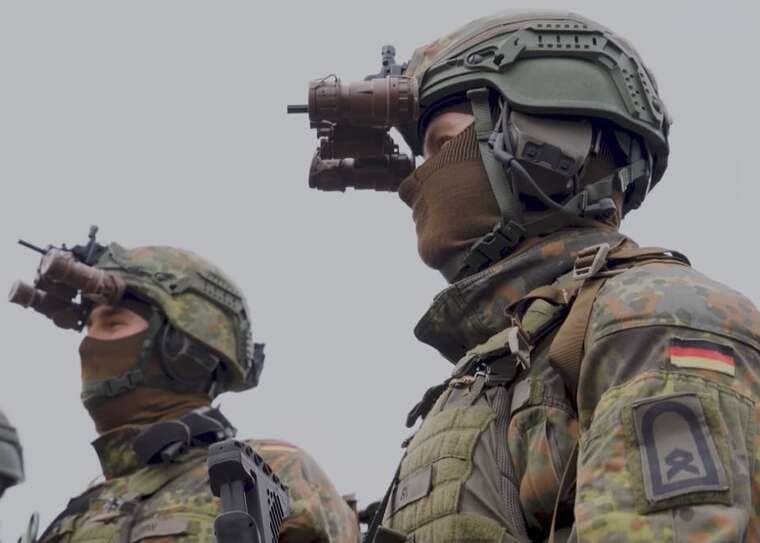
Germany will begin forming the first specialised unmanned systems regiment in the history of the Bundeswehr. The project is being developed taking into account the combat experience gained during the war between Russia and Ukraine. The new unit will be equipped with reconnaissance and strike drones, electronic warfare systems, interceptors for enemy aircraft, and long-range weapons.
Structure and personnel of the new unit
According to internal German government documents obtained by the journalistic outlet POLITICO, the regiment will consist of six companies. Each will be responsible for a specific area of combat application of unmanned systems. One company will operate directly near German troops, carrying out reconnaissance and attack missions. Another will specialise in countering enemy drones. Two more units will be responsible for operations at increasingly greater distances from the front line, while the longest-range strikes will be carried out by a separate Deep Strike group. A unit for the operational testing and implementation of new technologies is also planned.
German Defence Minister Boris Pistorius announced the intention to begin establishing the Bundeswehr's first drone unit in 2027. Initially, it will comprise around 350 servicemen, with the number planned to increase to approximately 600 by 2029.
Armament and technologies
According to estimates by German planners, purchasing thousands of drones for the new formation will require around €150 million. The list of armament combines developments by Ukrainian manufacturers, products of the German industry, and technologies from American companies. Seven of the nine systems mentioned in the documents are already being used in Ukraine.
Among the planned armament is an unmanned aerial vehicle with a reconnaissance range of up to 2,000 km, as well as the Ukrainian Flamingo cruise missile, developed by the company Fire Point. According to a German document, the missile's range exceeds 2,000 km. Ukraine is already using Flamingo to strike targets in Russia's deep rear.
In particular, this refers to the Termit ground robotic complex, developed in Ukraine. According to the concept of the German military, it can be equipped with a heavy machine gun. This platform has already carried out thousands of combat missions. Germany is financing the production of 2,000 such robots for Ukraine.
For reconnaissance near the front line, the Vector drone from the German company Quantum Systems is planned to be used, which is already in the service of the Ukrainian military. The American Bumblebee strike drone from Perennial Autonomy also belongs to this category. According to the publication, tens of thousands of such drones have been transferred to Ukraine.
To protect against enemy drones, the German regiment may receive the Merops system from the same American company. It is designed to intercept enemy drones, including Iranian Shaheds, which Russia is actively using against Ukraine. The system will be supplemented with equipment capable of detecting drones at a distance of up to 50 km.
At a greater distance from the front line, the Ukrainian Raybird reconnaissance drone and the American Hornet strike drone are planned to be used. According to POLITICO, in just three months of this summer, Ukraine used over 10,000 Hornet UAVs for strikes.
Change in Berlin's military doctrine
As noted by POLITICO, the decision demonstrates a change in Berlin's approach to military cooperation with Kyiv. If previously Germany mainly supplied Ukraine with weapons and military aid to counter Russia, it is now increasingly adopting Ukrainian combat experience and technologies to modernise its own army.
Ukraine has turned drones into one of the key instruments of modern war. They detect military positions and equipment, attack targets, destroy logistics routes in the rear, and intercept other drones. In June, former Ukrainian Defence Minister Mykhailo Fedorov stated that drones accounted for over 90% of enemy targets hit by Ukrainian forces.
«Для Німеччини підтримка України давно перестала бути одностороннім процесом» ("For Germany, supporting Ukraine has long ceased to be a one-way process"), Pistorius said during a meeting of countries providing military aid to Ukraine in Brussels on Tuesday. He emphasised that the Bundeswehr is studying Ukrainian experience in conducting combat operations, particularly the use of drones and military technologies.
The German Ministry of Defence did not confirm or deny the details of the internal plans. It noted that the final structure of the regiment is still being worked out.



Comments
No comments yet. Be the first!